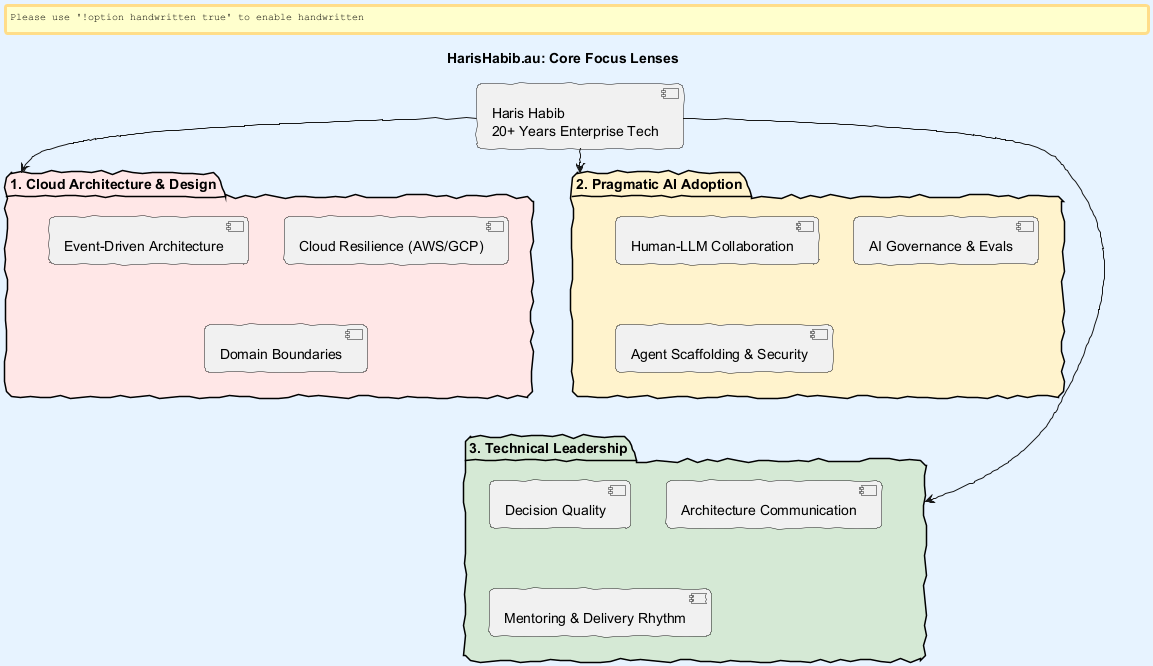
I’m Haris Habib, a Solution Architect based in Sydney with more than 20 years of experience in international payments, fintech, and enterprise technology.
Throughout my career, I have designed and worked with systems that move money across borders, operate under regulatory pressure, scale to high transaction volumes, and need to keep working when the easy path breaks.
That experience shapes how I think about technology.
I am interested in tools, platforms, and new architecture patterns. But I am more interested in what they make possible for real teams: clearer decisions, safer systems, faster learning, and better outcomes for customers.
This site is a living knowledge base for that work.
What This Site Is For
The goal is simple: make complex technology decisions easier to understand and easier to act on.
Most teams do not fail because they lack access to technology. They fail because the decision surface is messy:
- Too many cloud services with overlapping names.
- Too much AI hype and not enough operating discipline.
- Too many architecture diagrams that ignore team ownership.
- Too many delivery plans that assume production behaves like a slide deck.
I write for engineers, architects, product leaders, founders, and technology executives who want practical ways to make better decisions.
The Three Lenses
| Lens | What I cover | The practical question |
|---|---|---|
| System design and cloud architecture | Event-driven architecture, resilience, AWS and GCP trade-offs, domain boundaries, operating models. | How do we build systems that match the business and survive real conditions? |
| Pragmatic AI adoption | Human-AI collaboration, maturity models, governance, verification, agent infrastructure, production readiness. | How do we get useful AI value without losing trust, safety, or accountability? |
| Technical leadership | Decision quality, team clarity, architecture communication, mentoring, and delivery rhythm. | How do leaders help teams move faster without creating chaos? |
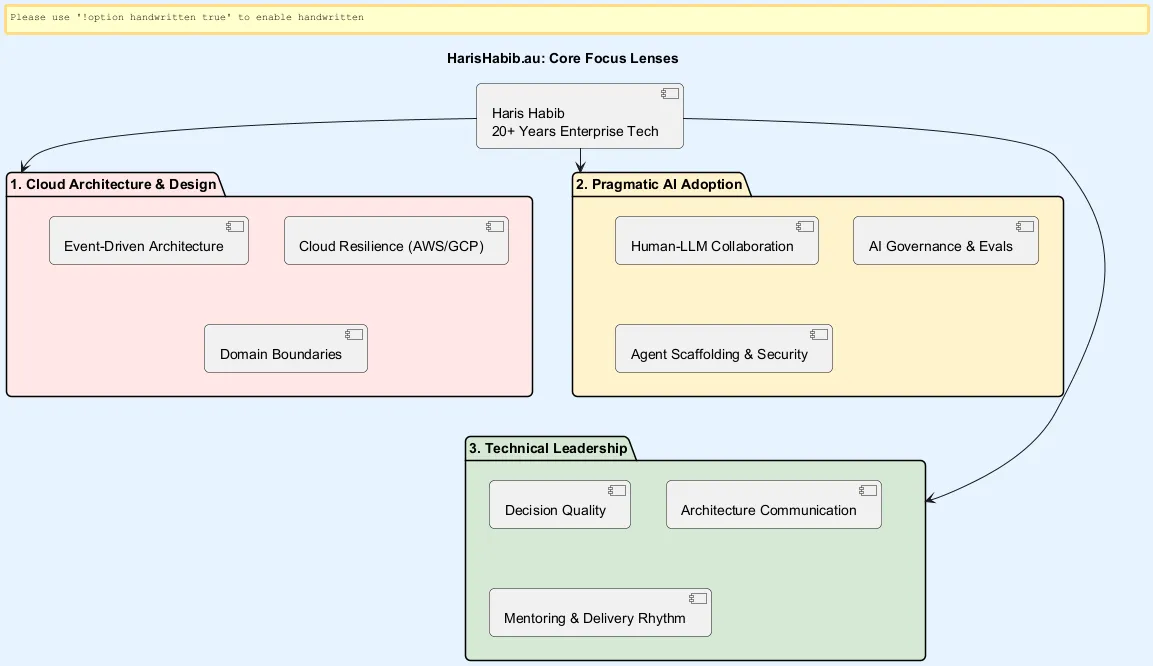
These areas are connected. Good architecture is not only a technical diagram. It is a decision system. Good AI adoption is not only a model choice. It is a workflow, risk, and accountability design. Good leadership is not only communication. It is creating the conditions where teams can make sound technical choices repeatedly.
Why Payments Shaped My View
Payments is a useful training ground because the margin for vague thinking is small.
A payment either moves or it does not. A settlement file balances or it does not. A fraud rule protects customers or it blocks legitimate activity. A platform outage is not an abstract reliability discussion; it is a customer, merchant, bank, or operator feeling the impact.
That environment teaches a few durable lessons:
- Reliability is a product feature.
- Architecture is an accountability model.
- Integration details become business risk.
- Observability matters most when the system is under stress.
- Trust is built through repeated, boring correctness.
Those lessons apply far beyond payments.
How To Use The Blog
| If you are thinking about… | Start with… | What you should get from it |
|---|---|---|
| AI adoption without hype | Beyond the Hype | A realistic view of AI’s promise, risks, and operating constraints. |
| Safe human-AI workflows | The Human-AI Partnership | A framework for where AI assists, where humans decide, and how verification works. |
| AI roadmap planning | AI Maturity Stages | A way to identify your current stage and the next responsible move. |
| Agent infrastructure | The Docker Moment for AI Agents | A production-readiness lens for agents, tools, evals, permissions, and observability. |
| Event-driven systems | Event-Driven Architecture in Practice | Practical AWS and GCP implementation patterns. |
| Resilient cloud design | Resilience Engineering in the Cloud | A failure-first approach to building systems that recover gracefully. |
| Australia’s AI ecosystem | Australia’s AI Incubator Problem | A market-level view of AI startup formation, scale-up gaps, and sovereign capability. |
The Standard I Am Aiming For
Every post should help a reader do at least one of three things:
- Understand a complex technology shift in plain language.
- Make a better architecture or product decision.
- Ask a sharper question inside their own organisation.
The Security And Well-Architected Lens
I will keep coming back to two quality questions.
| Lens | The question I care about |
|---|---|
| Security | What could break trust, expose data, weaken access boundaries, or make accountability unclear? |
| Well-Architected | Is the system operable, secure, reliable, cost-aware, performant enough, and able to improve over time? |
Those gaps are often where promising technology efforts fail. A cloud migration that ignores operations is not mature. An AI pilot that ignores identity and audit is not safe. An event-driven system without replay and ownership is not resilient. An agent workflow without tool boundaries is not production-ready.
The point is not to slow teams down.
It is to help them move faster without quietly accumulating risk.
That is the editorial bar.
Not content for content’s sake.
Not hype.
Not diagrams that look clever but do not change the decision.
Useful thinking, written clearly.
Welcome to the conversation.