
It is a beautiful morning in Sydney, and I am sitting with coffee, a laptop, and the strange feeling that we are living through one of those technology shifts that will be obvious only in hindsight.
Twenty years ago, I was starting my career in payments, excited by the promise of digital transformation. The work was practical: make payments more reliable, reduce friction, protect customers, and help systems move money safely at scale.
Today, AI is creating a different kind of shift. It is not only making existing work faster. It is changing who can explore ideas, build prototypes, analyse information, and express intent through software.
I am optimistic about that.
But optimism is not the same as hype.
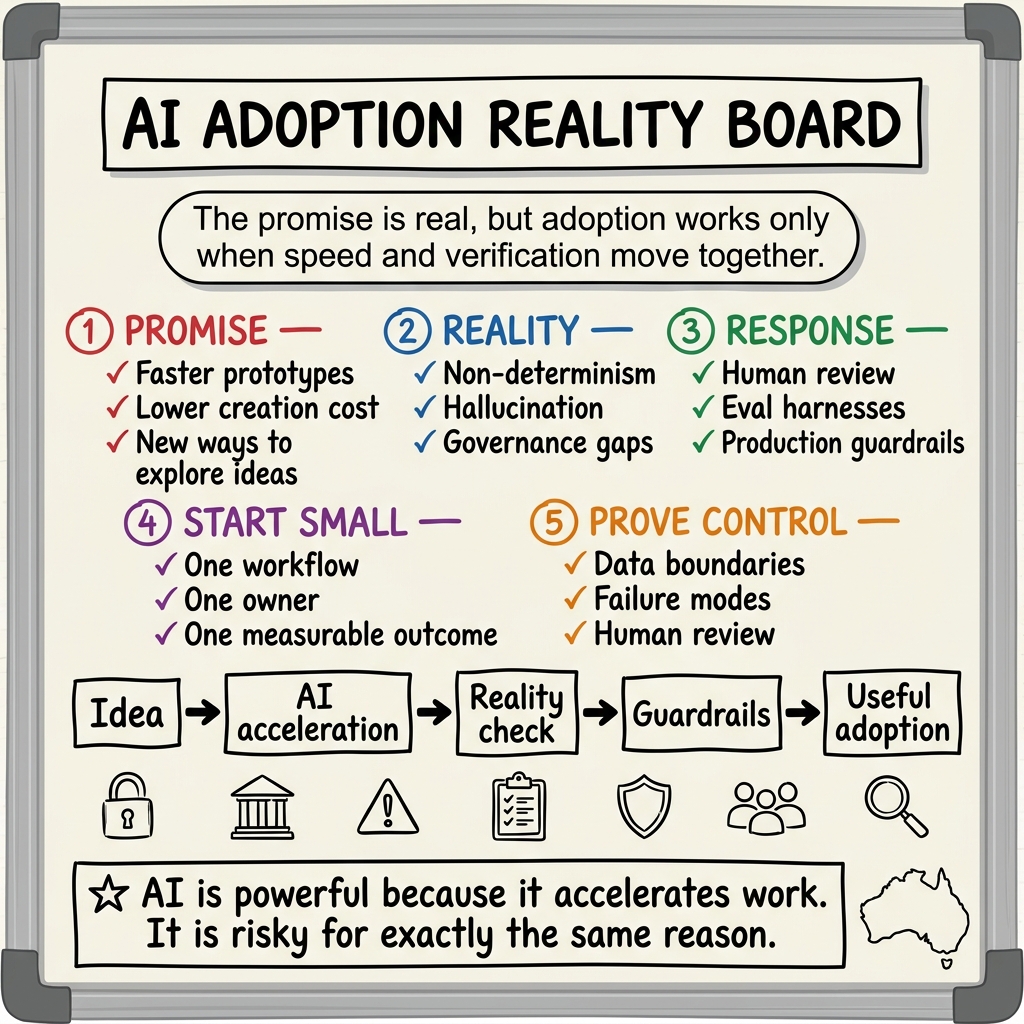
AI adoption becomes valuable only when speed is matched with verification. Without that, the same capability that helps a team move faster can also help it make mistakes faster.
The Promise: AI As The Great Unblocker
The most exciting part of AI is not that it writes text or generates code. It is that it reduces the distance between an idea and a testable version of that idea.
After two decades of watching good ideas die because they were too expensive, too complex, or required teams that were not available, this matters.
From Idea To Working Prototype
Previously, turning a concept into something tangible often meant weeks or months of planning, design, development, environment setup, and stakeholder negotiation.
Now, a founder, engineer, analyst, or product manager can move from rough thought to prototype much faster.
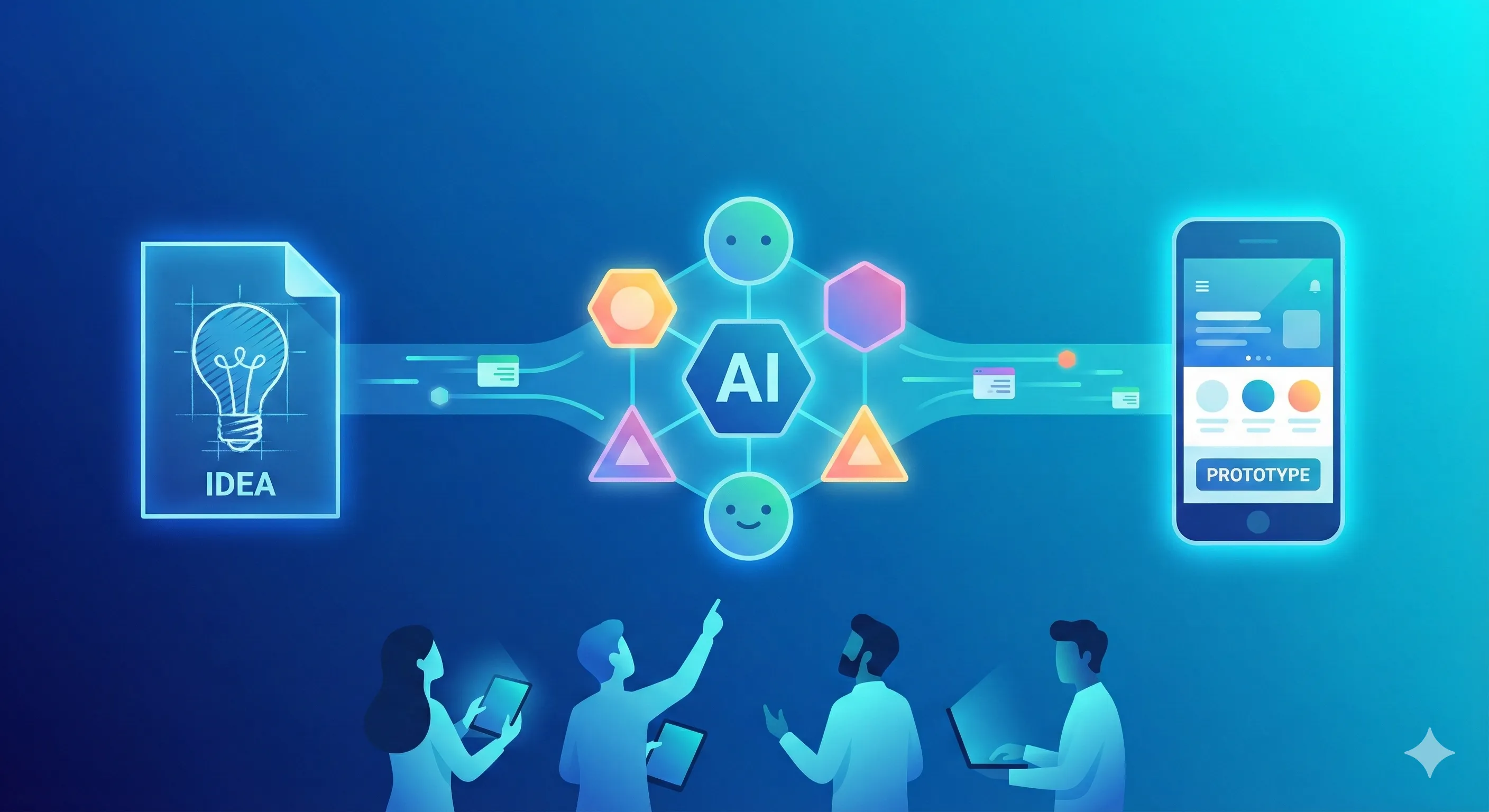
That does not mean the prototype is production-ready.
It means the feedback loop has collapsed.
| Before AI | With AI assistance | What changes |
|---|---|---|
| Long gap between idea and artefact | Fast first draft, prototype, mockup, or analysis | More ideas can be tested before politics harden around them. |
| Specialist bottlenecks for early exploration | Non-specialists can create useful starting points | Experts can spend more time refining and validating. |
| Meetings before evidence | Evidence before meetings | Teams can discuss something concrete. |
| Expensive experimentation | Lower-cost experimentation | Learning becomes cheaper. |
McKinsey’s State of AI research shows how quickly generative AI adoption has moved from curiosity to mainstream experimentation. The important point for leaders is not the headline adoption number. It is the operating implication: more of your people will be able to create, analyse, and automate than before.
That is a profound organisational shift.
Cloud Integration Is The Hidden Accelerator
AI becomes much more powerful when it is connected to cloud services, workflow tools, APIs, and internal systems.
In payments, that matters enormously. Fraud detection, dispute handling, customer support, transaction monitoring, developer productivity, and operational analytics all become more interesting when AI can sit beside real workflows rather than outside them.
But the same integration that creates value also creates risk.
An AI tool connected to nothing is limited. An AI tool connected to everything is dangerous. The serious work is deciding what it should be allowed to see, what it should be allowed to do, and where humans must remain accountable.
The Reality Check
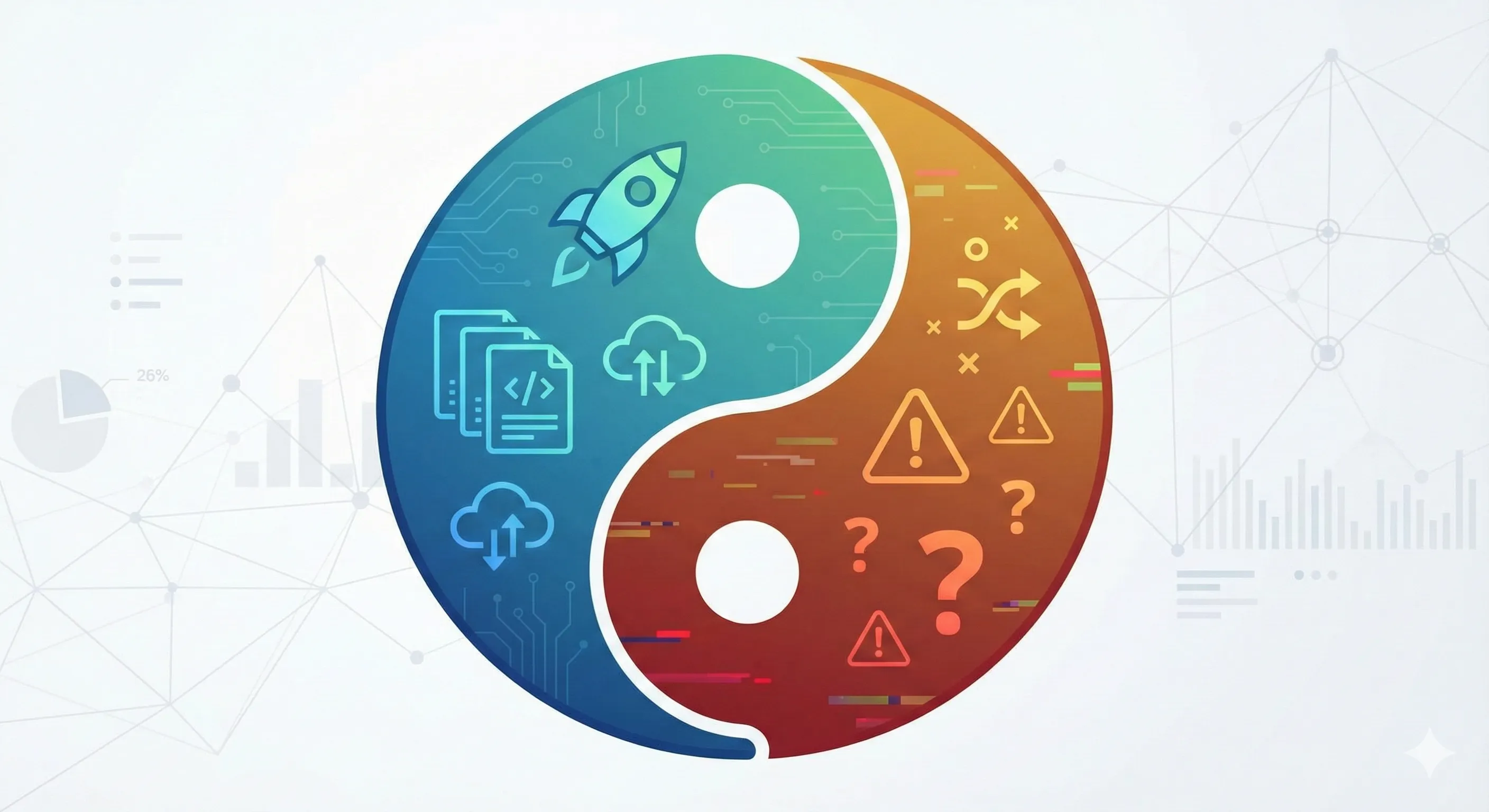
AI is powerful because it is probabilistic, creative, and flexible.
AI is risky for the same reason.
The Determinism Gap
Traditional software engineering trains us to expect deterministic behaviour. The same input should produce the same output. If it does not, we call that a bug.
AI systems are different. They can produce different answers to similar prompts. They can make confident mistakes. They can respond well in a demo and fail in a slightly different production context.
In a creative workflow, that flexibility is useful.
In a payment, compliance, security, legal, or customer-impacting workflow, that flexibility must be controlled.
The Trust Problem
The uncomfortable truth is that AI introduces a trust gap.
You are often using output from a system whose reasoning you cannot fully inspect, whose training data you did not curate, and whose behaviour may shift as models, prompts, context, and tool access change.
That does not make AI unusable.
It means AI must be wrapped in an operating model.
| Risk | What it looks like | Control |
|---|---|---|
| Hallucination | The system invents facts, links, data, or explanations. | Require sources, retrieval, evals, and human verification for important outputs. |
| Data leakage | Staff paste sensitive data into unapproved tools. | Set approved tools, data rules, redaction, and monitoring. |
| False confidence | A fluent answer sounds more reliable than it is. | Train teams to inspect evidence, not tone. |
| Workflow drift | Teams create AI shortcuts outside governance. | Give teams safe patterns so they do not improvise risky ones. |
| Accountability blur | Nobody knows who owns the final decision. | Define where AI suggests and where humans approve. |
BCG reported that many companies still struggle to achieve and scale tangible AI value. That should not surprise us. The barrier is rarely only the model. It is the combination of workflow design, measurement, governance, data quality, and change management.
What A Pragmatic AI Program Looks Like
The companies that win with AI will not be the loudest adopters.
They will be the most disciplined.
The 10-Star Test
| Question | Weak answer | Strong answer |
|---|---|---|
| What problem are we solving? | ”We need an AI strategy." | "We want to reduce fraud-review handling time by 30% without increasing false positives.” |
| What data is involved? | ”The team will use what they need." | "Approved data sources, retention rules, and redaction are defined.” |
| Who checks the output? | ”People will use judgment." | "Named reviewers approve outputs above a risk threshold.” |
| How do we measure success? | ”People seem faster." | "Cycle time, error rate, cost, and customer impact are measured.” |
| What happens when it fails? | ”We will investigate." | "Fallback path, audit trail, and rollback process are clear.” |
AI adoption should begin with a narrow use case, a named owner, a measurable outcome, and a verification path.
That is less glamorous than a sweeping enterprise transformation deck.
It is also how value actually appears.
Security And Well-Architected Gaps To Call Out
AI adoption creates a new security surface because people, prompts, data, tools, and third-party models meet inside the same workflow.
| Gap | What it looks like | What good looks like |
|---|---|---|
| Broken access boundaries | AI tools can see more data than the user should access. | AI inherits least-privilege identity and only retrieves authorised data. |
| Sensitive data exposure | Staff paste customer, payment, legal, or commercial data into unapproved tools. | Approved tools, redaction, data classification, and logging rules are clear. |
| Prompt injection | Untrusted content manipulates the model into ignoring instructions or leaking data. | Retrieval, tool use, and output handling are designed as hostile-input paths. |
| No eval gate | Teams ship prompts because demos worked. | Evals test quality, safety, hallucination, and failure behaviour before rollout. |
| No operating owner | Nobody owns AI drift, cost, incidents, or policy updates after launch. | Every AI workflow has product, technical, risk, and operational ownership. |
From a Well-Architected perspective, the common gap is not “we need more AI.” It is that teams skip operational excellence, security, reliability, performance, and cost thinking until after the pilot has already spread.
Where To Start
Start with a workflow that is:
- valuable enough to matter
- repetitive enough to learn from
- bounded enough to control
- data-rich enough for AI to help
- low-risk enough to pilot safely
- observable enough to measure
Then ask three questions before buying anything:
- What decision or output will AI assist with?
- Who remains accountable for the final result?
- What evidence will prove the workflow is better?
If those answers are vague, the project is not ready.
The Real Opportunity
AI is not a silver bullet. It is a leverage tool.
It amplifies intent. It accelerates exploration. It lowers the cost of trying. It can also amplify confusion, weak governance, and bad assumptions.
The opportunity is real.
The challenge is to build enough structure around AI that people can use it with confidence.
That is why the future of AI adoption is not only about better models. It is about better workflows, better verification, better leadership, and better judgment.
References
- McKinsey: The State of AI
- BCG: AI Adoption in 2024 - Scaling Challenges
- OWASP Top 10 for LLM Applications
- AWS Well-Architected Framework
- Google Cloud Well-Architected Framework
- PYMNTS: AI Fraud Detection in Financial Institutions
- PYMNTS: AI Hallucination Business Impacts
Written by Haris Habib from Sydney, Australia | December 2025