In the first post, we looked at the promise and risks of AI adoption. In the second post, we explored how human judgment and AI capability can work together safely.
The next question is more practical:
Where is your organisation today?
Most AI programs struggle because leaders try to scale before they understand their current maturity. They move from scattered experiments straight to enterprise ambition, skipping the governance, data, workflow, and measurement foundations that make AI trustworthy.
The result is predictable: pilots that look impressive, but do not become durable business capability.
The Australian Context
In Sydney, I see Australian financial services, fintech, and enterprise teams approaching AI with a useful kind of pragmatism.
They are interested in the upside, but they also operate under regulatory, customer, operational, and reputational constraints. Bodies such as ASIC and APRA shape an environment where accountability matters.
That pressure can feel slow.
It is also a forcing function for better practice.
Regulated industries cannot afford AI theatre. They need adoption that is measurable, governed, and recoverable.
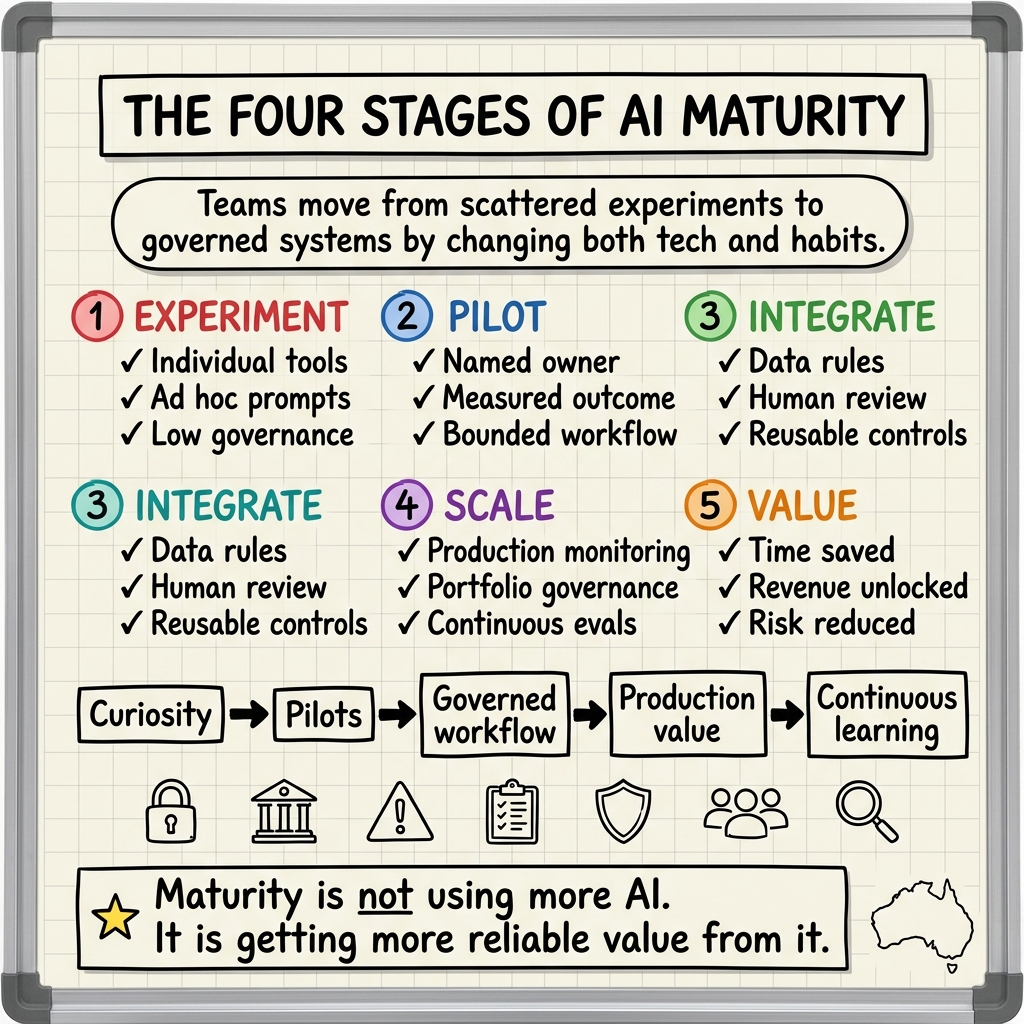
The 4 Stages Of AI Maturity
| Stage | What it looks like | Main risk | The next responsible move |
|---|---|---|---|
| 1. Experimentation | Individuals use public or approved AI tools for isolated tasks. | Value is scattered and data risk is unmanaged. | Pick one bounded use case and define success. |
| 2. Piloting | Teams run formal pilots with named owners and success metrics. | Pilots succeed locally but cannot scale. | Build governance, data rules, and repeatable patterns. |
| 3. Structured integration | AI workflows are connected to systems, policies, and human review. | Delivery slows if governance becomes bureaucracy. | Standardise reusable controls and measure portfolio value. |
| 4. Scaled production | AI is embedded in enterprise workflows with monitoring and accountability. | Drift, complacency, and unmanaged expansion. | Continuously evaluate, retrain, monitor, and improve. |
The goal is not to rush to Stage 4.
The goal is to know which stage you are in and make the next move deliberately.
Stage 1: Experimentation
At this stage, individuals or small teams use AI tools for isolated tasks: summarising documents, drafting emails, writing code snippets, brainstorming, or analysing small pieces of information.
This stage is useful. People learn what AI is good at. They discover where it is unreliable. They build intuition.
But Stage 1 becomes risky when the organisation pretends informal use is not happening.
Signs You Are Here
- Developers are using AI assistants, but policy is unclear.
- Business teams paste content into tools without knowing the data rules.
- No one is measuring impact.
- “AI strategy” exists as a boardroom phrase, not an operating plan.
- Teams cannot distinguish approved tools from shadow AI usage.
Your Next Move
Choose one high-value, low-risk workflow and turn it into a formal pilot.
Do not begin with enterprise transformation. Begin with a measurable workflow.
Stage 2: Piloting
At Stage 2, the organisation has identified specific use cases and assigned teams to test them.
This is where AI starts becoming real.
The best pilots have:
- a named owner
- a clear user
- a measurable outcome
- a defined data boundary
- a review process
- an explicit stop/go decision
The danger is pilot theatre: many experiments, lots of demos, no repeatable operating model.
Signs You Are Here
- You have one to three defined AI use cases.
- Someone is tracking time saved, cost reduced, risk reduced, or quality improved.
- A small team is enthusiastic, but the rest of the organisation has not changed.
- Security, privacy, legal, and architecture reviews happen manually each time.
- Successful pilots do not yet become reusable patterns.
Your Next Move
Build the scaffolding before scaling: governance, data rules, human review thresholds, evals, observability, and deployment patterns.
This is the stage many organisations try to skip.
Stage 3: Structured Integration
Stage 3 is the critical leap.
AI moves from isolated pilots into real workflows. It connects with enterprise systems, customer processes, developer platforms, analytics, and decision pipelines.
This is where the human-AI partnership model becomes operational rather than theoretical.
Signs You Are Here
- An AI governance model exists and is used.
- Data access and privacy protocols are documented.
- Human oversight is designed into workflows.
- Evaluation suites test AI outputs before rollout.
- Multiple teams use shared standards instead of inventing their own controls.
- The organisation can explain which AI workflows are in production and who owns them.
Your Next Move
Turn governance into acceleration.
Good governance should not be a maze. It should give teams reusable patterns: approved tools, standard risk tiers, prompt and eval templates, review gates, logging requirements, and deployment paths.
Stage 4: Scaled Production
At Stage 4, AI is embedded in enterprise workflows and contributes measurable value.
This is not the end of the journey.
It is the beginning of operational discipline.
AI systems need monitoring, retraining, cost control, model updates, policy review, and incident response. A workflow that was safe six months ago may become risky if data changes, user behaviour shifts, model versions change, or the business process evolves.
Signs You Are Here
- AI contributes measurable revenue, cost savings, risk reduction, or service improvement.
- Dashboards track quality, latency, cost, usage, and exceptions.
- Model, prompt, tool, and data changes go through release control.
- Audit trails show who reviewed what and why.
- There is a process for incidents, rollback, and continuous improvement.
Your Next Move
Treat AI like a production system, not a one-time transformation.
The Common Mistakes
| Mistake | What happens | What to do instead |
|---|---|---|
| Skipping Stage 3 | Pilots succeed but cannot scale safely. | Build reusable governance before broad rollout. |
| Staying in Stage 1 | Informal usage grows without measurable value or control. | Pick a formal pilot with a clear owner and metric. |
| Measuring activity instead of impact | Teams report prompts, users, and demos rather than outcomes. | Measure time, quality, revenue, risk, or customer impact. |
| Treating governance as paperwork | Teams avoid the process or invent workarounds. | Make governance a reusable delivery toolkit. |
| Scaling without ownership | Nobody knows who monitors, fixes, or approves the AI workflow. | Assign product, technical, risk, and operational owners. |
Security And Well-Architected Gaps By Stage
Each maturity stage has a different failure pattern.
| Stage | Security gap to call out | Well-Architected gap to call out |
|---|---|---|
| Experimentation | Shadow AI usage, unapproved tools, and sensitive data pasted into public systems. | No ownership, no measurement, no cost visibility, and no repeatable delivery pattern. |
| Piloting | Pilots use privileged data or broad tool access because the scope feels temporary. | Success metrics focus on demos rather than reliability, observability, and supportability. |
| Structured integration | AI is connected to systems before identity, audit, approval, and rollback are mature. | Governance becomes manual review rather than reusable guardrails and platform patterns. |
| Scaled production | Drift, prompt changes, data changes, or model upgrades alter behaviour without enough review. | Monitoring misses quality, cost, latency, failure recovery, and business-impact signals. |
The security bar should rise with each stage. So should the architecture bar. A Stage 4 AI workflow should be treated like production software: tested, observable, owned, cost-aware, secure by design, and recoverable.
The Maturity Self-Assessment
Ask these questions honestly:
| Question | If the answer is no… |
|---|---|
| Do we know which AI tools are being used? | You are still in Stage 1. |
| Do our pilots have measurable business outcomes? | Your pilot portfolio is not ready to scale. |
| Do we have data and privacy rules that teams understand? | Your risk surface is unclear. |
| Do we know where humans must approve AI outputs? | Your accountability model is weak. |
| Do production AI workflows have monitoring and incident paths? | You are not yet at Stage 4. |
Your Next Move
If you are in Stage 1, choose one bounded pilot.
If you are in Stage 2, resist the urge to scale and build the governance layer first.
If you are in Stage 3, standardise patterns so teams can move faster with less friction.
If you are in Stage 4, focus on monitoring, drift, cost, retraining, incident response, and continuous improvement.
The journey from experimentation to scaled production is not always fast.
But it is predictable.
Understanding your stage gives you the confidence to invest in the right thing next.
References
- BCG: AI Adoption in 2024 - Scaling Challenges
- OWASP Top 10 for LLM Applications
- Google Cloud Well-Architected Framework
Written by Haris Habib from Sydney, Australia | December 2025 This is the third post in a multi-part series on AI adoption.