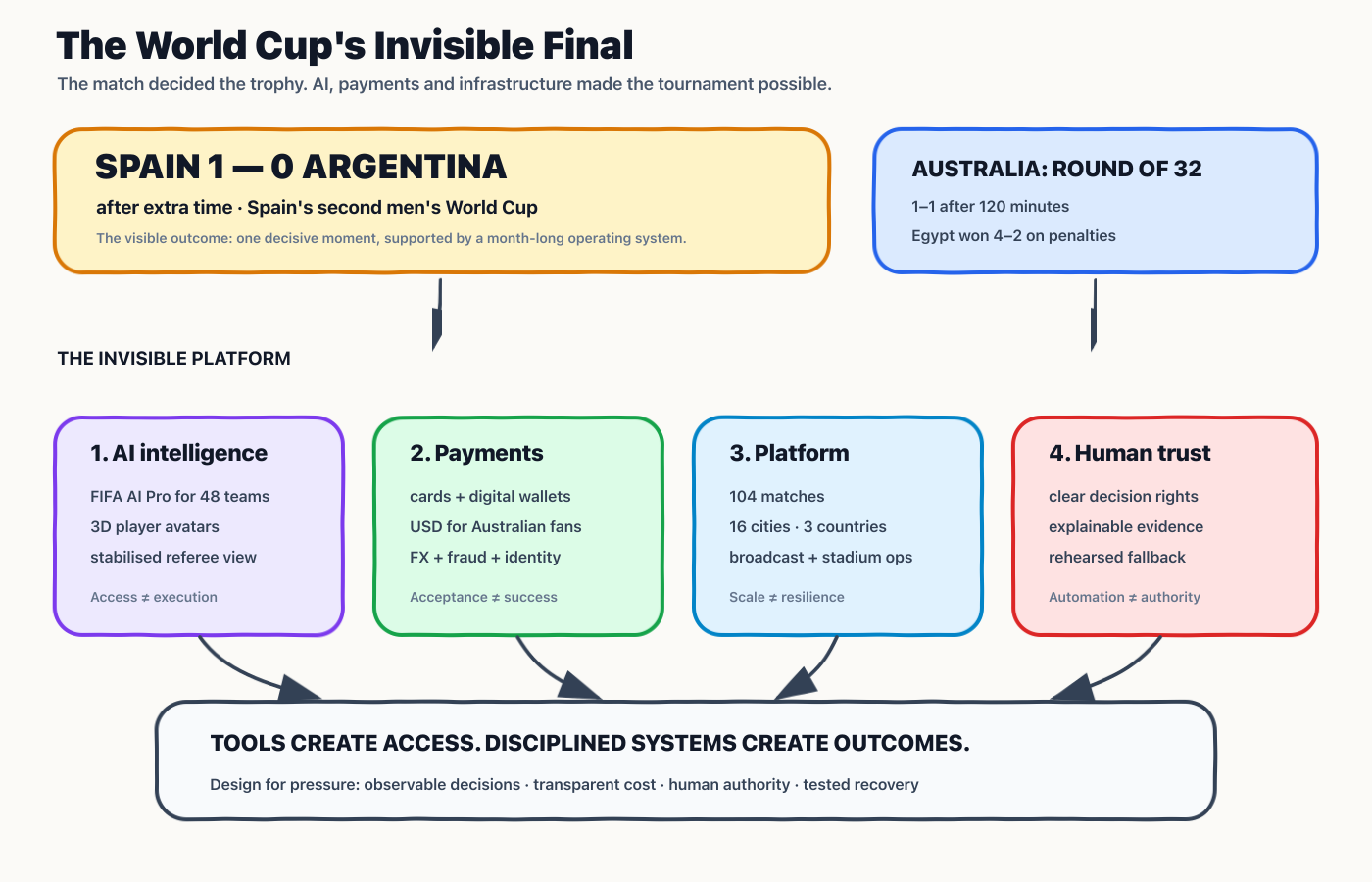
Spain lifted the trophy.
Argentina lost its crown.
Australia reached the new Round of 32.
Underneath the football, the world’s largest sporting event ran an equally interesting tournament in AI, payments and technology.
Spain beat the mighty defending champions Argentina 1-0 after extra time in New York New Jersey on 19 July. Ferran Torres scored the goal that gave Spain its second men’s World Cup.
For Argentina, it was the end of a title defence that had reached the last possible match. For Spain, it was proof that a repeatable system can keep producing under pressure.
Australia’s tournament ended earlier, but not quietly. The Socceroos beat Türkiye, lost to the United States and drew with Paraguay to finish second in Group D. They then drew 1-1 with Egypt across 120 minutes before losing the Round of 32 shootout 4-2.
Those are football outcomes.
But for anyone working in AI, payments, fintech or large-scale platforms, the tournament exposed another competition: the one between technology that looks impressive in a demonstration and a system that still works in front of millions of people.
Disclaimer: This article is personal analysis and general commentary. It is not financial, investment, legal, regulatory or engineering advice. References to FIFA, Visa, Lenovo, participating teams and other third parties do not imply endorsement, affiliation or partnership.
The visible game and the invisible platform
The visible product was football: 48 teams, 104 matches, 16 host cities and three countries.
The invisible product was a continent-scale platform connecting:
- ticketing, identity and access
- domestic and cross-border payments
- stadium and broadcast infrastructure
- match, player and tracking data
- AI-assisted analysis
- officiating technology
- cyber, fraud and operational controls
- millions of individual customer journeys
Supporters experienced a match. The platform had to experience every dependency at once.
That distinction matters because digital businesses often obsess over the visible feature while customers judge the entire chain. A ticket is not successfully sold because the checkout page loaded. It is sold when the payment is authorised, foreign exchange is understood, fraud controls do not reject the genuine fan, confirmation arrives, the ticket resolves to the correct identity and access works at the stadium.
The goal is the moment people remember.
The platform is everything that had to work for the moment to exist.
AI gave every team a tool. It did not give every team the same outcome.
FIFA AI Pro was made available to all 48 participating teams. According to FIFA, every team used it during the tournament, across 15 languages.
The system combined AI agents, official event and tracking data, video, 3D material and a specialised football language model. It allowed coaching and analysis teams to query match data in natural language and generate structured tactical insights.
That is a meaningful democratisation of capability. A smaller federation could access analytical machinery that previously favoured teams with large technical budgets.
But all 48 teams having the same tool did not make all 48 teams equally good.
This is the enterprise AI lesson hiding in the tournament.
| What becomes widely available | What still differentiates the outcome |
|---|---|
| Foundation models | Domain context |
| Natural-language access to data | Quality and ownership of the data |
| Generated analysis | The questions people choose to ask |
| Recommendations | Human judgement about what to use |
| Faster insight | Execution under real pressure |
| The same tool | The operating system around the tool |
The model is not the moat when everyone can access it.
The moat becomes the discipline around it: trusted inputs, good questions, clear decision rights, experienced people and fast feedback between insight and action.
Spain did not win because an AI system selected a winning prompt. Argentina did not lose because it lacked data. Australia did not leave the tournament because its analysts lacked a dashboard.
AI could compress the distance between raw data and a useful question. People still had to turn that into a decision—and players still had to execute it.
This is why one model is the wrong default. The value sits in routing, context, controls and the quality of the operating model around the technology.
The best AI boundary at the tournament was deliberately human
The tournament also showed a sensible boundary for high-impact AI.
FIFA AI Pro was available for analysis before and after matches, not for live use from the technical area during play. AI-assisted 3D player avatars improved tracking and the visualisation of semi-automated offside decisions. Referee View used algorithmic stabilisation to turn a difficult camera feed into useful broadcast footage.
In each example, AI had a defined job:
- organise and retrieve complex evidence
- improve the precision of a measurement
- make a decision easier to understand
- remove noise from a human-facing signal
It did not remove human accountability for the match.
That is a far better design pattern than “put AI in the loop” as a vague ambition.
| AI role | Human role |
|---|---|
| Process high-volume match data | Decide which question matters |
| Surface tactical patterns | Select and communicate the response |
| Improve an offside evidence model | Retain officiating authority |
| Stabilise a referee camera feed | Interpret the event in context |
For an Australian bank, insurer, fintech or RegTech, the domain changes but the architectural principle holds: define what the AI may recommend, what it may decide, what evidence it must retain and when authority returns to a person.
Human oversight is not a decorative approval button. It is a designed operating boundary.
The payment journey started long before the stadium
The World Cup was also a massive cross-border commerce event.
FIFA’s ticketing guidance listed Visa cards, Apple Pay and Google Pay among the supported methods during the last-minute sales phase. Residents of Canada were charged in Canadian dollars, residents of Mexico in Mexican pesos and residents of the United States in US dollars. International supporters—including Australians—were also charged in US dollars.
That simple rule opens a large payments architecture behind the screen:
Australian supporter
        ↓
FIFA ticket checkout in USD
        ↓
wallet or card credential → token / account reference
        ↓
fraud and authentication decision
        ↓
issuer authorisation + FX treatment
        ↓
confirmation, ticket identity and later dispute path
Every arrow carries a failure mode.
The genuine customer may be rejected because a large, unusual overseas purchase looks suspicious. A fraudulent transaction may be approved because the signals arrived too late. The customer may understand the ticket price but not the eventual foreign-exchange cost. A wallet may simplify credential presentation while leaving the underlying card economics intact. A chargeback may arrive long after the event inventory can be resold.
The payment industry’s contribution is mostly invisible when it succeeds. That is exactly why major events are useful stress tests: demand concentrates, urgency rises, fraud follows attention and customers have little patience for a retry.
The Australian payment connection is more direct than it looks
The Reserve Bank of Australia’s 2025 Consumer Payments Survey found that cards remained the country’s most widely used consumer payment method. Forty-three per cent of consumers used a mobile device to make a contactless payment during the survey week, up from 35 per cent in 2022.
That means the wallet behaviour seen in global ticketing is not a distant trend. Australian consumers already expect the credential, device and payment experience to feel like one action.
But a smooth customer gesture does not mean a simple payment underneath.
In its March 2026 conclusions on merchant card costs, the RBA found that foreign-issued card transactions represented about 3 per cent of Australian card transactions but 20 per cent of interchange paid by acquirers. It estimated weighted-average interchange on those transactions at about 1.75 per cent and decided on a 1 per cent cap from 1 April 2027.
The World Cup flow ran in the other direction—Australian-issued credentials used for an overseas purchase—but it makes the same system issue tangible. Cross-border acceptance still carries additional cost, fraud, FX, scheme and dispute complexity.
The Australian opportunity is not merely to make cards faster. It is to make cross-border payments:
- more transparent before authorisation
- better at distinguishing a travelling customer from an attacker
- easier to trace across providers
- capable of showing total cost, not just the headline price
- resilient when one participant or rail is degraded
The RBA’s February 2026 cross-border payments review emphasised the same outcomes: transparency of total transaction cost, clearer delivery times and better payment-status tracking.
A ticketing spike makes those goals visible. Everyday remittances, travel purchases and small-business commerce make them important.
AI is about to become a participant in the payment, not just a fraud model
There is a second connection between the tournament’s AI and payment layers.
AI in payments has traditionally sat behind the transaction: scoring fraud, resolving alerts, forecasting liquidity or routing support cases.
Agentic commerce moves AI in front of the transaction. An agent may search for an event, compare tickets, select a seat, choose a stored payment method and attempt the purchase on a customer’s behalf.
The RBA’s 2026 review explicitly considered this possibility. It noted that AI agents located outside Australia could act as intermediaries between Australian consumers and merchants, potentially turning what would have been a domestic-card transaction into a foreign-card transaction.
That is not just a checkout feature. It creates new architecture questions:
- Who authorised the agent to transact?
- What amount, merchant category, currency and time window were approved?
- Can the customer see why one offer or payment method was selected?
- Who carries liability when the agent buys the wrong product?
- Does delegated authentication survive the merchant and issuer journey?
- Could the agent’s routing unintentionally make the payment more expensive?
- What evidence is available when the customer disputes the purchase?
An AI agent buying a World Cup ticket sounds convenient.
An AI agent entering a scarce, time-sensitive, cross-border purchase with dynamic fraud controls is a serious trust architecture.
Payments firms that treat agentic commerce as another front end will miss the point. It is a new actor in the transaction model.
Australia reached the Round of 32 through resilience, not perfection
The Socceroos’ run offers a more grounded lesson for Australian technology teams.
Australia did not dominate every match. It beat Türkiye 2-0, lost 2-0 to the United States and drew 0-0 with Paraguay. That was enough to advance as the group’s runner-up.
Against Egypt, Australia stayed in the contest for 120 minutes and reached penalties at 1-1. The shootout ended the run.
In a tournament—and in a production system—progress rarely comes from a flawless path. It comes from staying inside the contest after the first plan fails.
That is operational resilience in plain language:
| Tournament behaviour | Technology equivalent |
|---|---|
| Adapt after a loss | Change the operating plan after an incident |
| Qualify across three different results | Avoid depending on one perfect path |
| Prepare for extra time | Size capacity beyond the expected case |
| Rehearse penalties | Test the high-pressure fallback before it is needed |
| Review the tournament honestly | Turn incidents and near misses into evidence |
Reaching the Round of 32 was not the trophy. It was still a credible outcome in the first 48-team World Cup, followed by a failure mode that could not be hidden: the shootout.
Good technology leadership does the same. It celebrates progress without confusing progress with completion, then studies the point where the system stopped.
What Spain’s win should mean to a technology leader
Spain’s final victory and Argentina’s loss can be reduced to one goal.
That would miss the system around it.
My broader reading of this World Cup is:
- Tools create access. Systems create advantage. Every team could use FIFA AI Pro. One team still had to turn preparation into the tournament’s best result.
- The last mile remains human. AI can compress evidence and improve a decision surface. It cannot remove the need for accountable judgement and execution.
- Payments are part of the product. Cross-border authorisation, FX transparency, fraud controls and ticket identity shape the fan experience as much as the checkout design.
- Scale exposes architecture. A platform spanning 104 matches and three countries cannot rely on the happy path.
- Resilience is rehearsed. Australia’s run showed the value of staying competitive across different conditions. Its shootout exit showed why the fallback must work under the highest pressure.
Spain won the World Cup.
Argentina reminded us that even the defending champion and the greatest talent can reach the end of a cycle.
Australia reminded us that a team can advance without being perfect—and that the final failure deserves as much study as the earlier success.
The technology lesson is the same across all three.
Do not confuse access to a powerful tool with the ability to win.
Build the system around it.