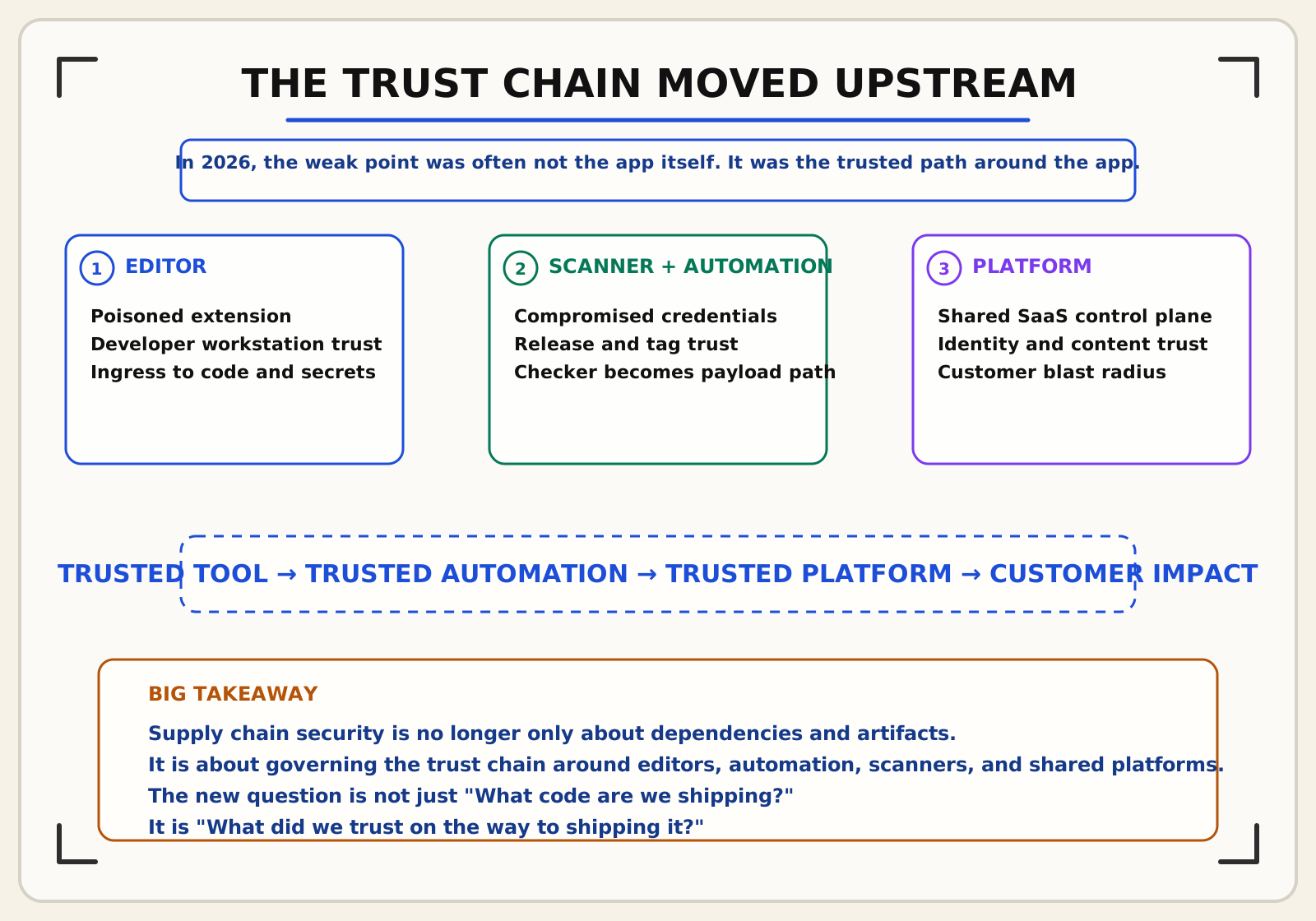
Attackers no longer need to break your production app first.
They can stand in the software path your team already trusts.
The editor. The scanner. The platform.
That is the new supply chain problem.
The Pattern Showed Up In Three Different Places
Between 19 March 2026 and 26 May 2026, three different incidents hit three different parts of the software delivery path.
At first glance, they do not look identical.
One involved a poisoned VS Code extension and GitHub employee device compromise. One involved malicious releases of a popular security scanner. One involved repeated unauthorized activity inside a shared SaaS platform used by thousands of institutions.
But the deeper lesson is the same.
The trusted path around software has become part of the attack surface.
| Date | Surface | What happened | What it means |
|---|---|---|---|
| 19 March 2026 | Scanner and release automation | Aqua said a threat actor used compromised credentials to publish malicious trivy releases and tamper with trivy-action and setup-trivy. | The security tool can become the payload path. |
| 29 April and 7 May 2026 | Shared SaaS platform | Instructure said Canvas experienced unauthorized activity on 29 April and a second exploited vulnerability on 7 May. | A platform your organisation depends on can become a control-plane risk. |
| 18 May 2026, disclosed 20 May and updated 26 May 2026 | Developer workstation and internal repositories | GitHub said a poisoned third-party VS Code extension led to compromise of an employee device and exfiltration of internal repositories. | The editor can become the ingress point. |
This is not just “three bad weeks for security.”
It is a clearer map of where modern engineering trust really lives.
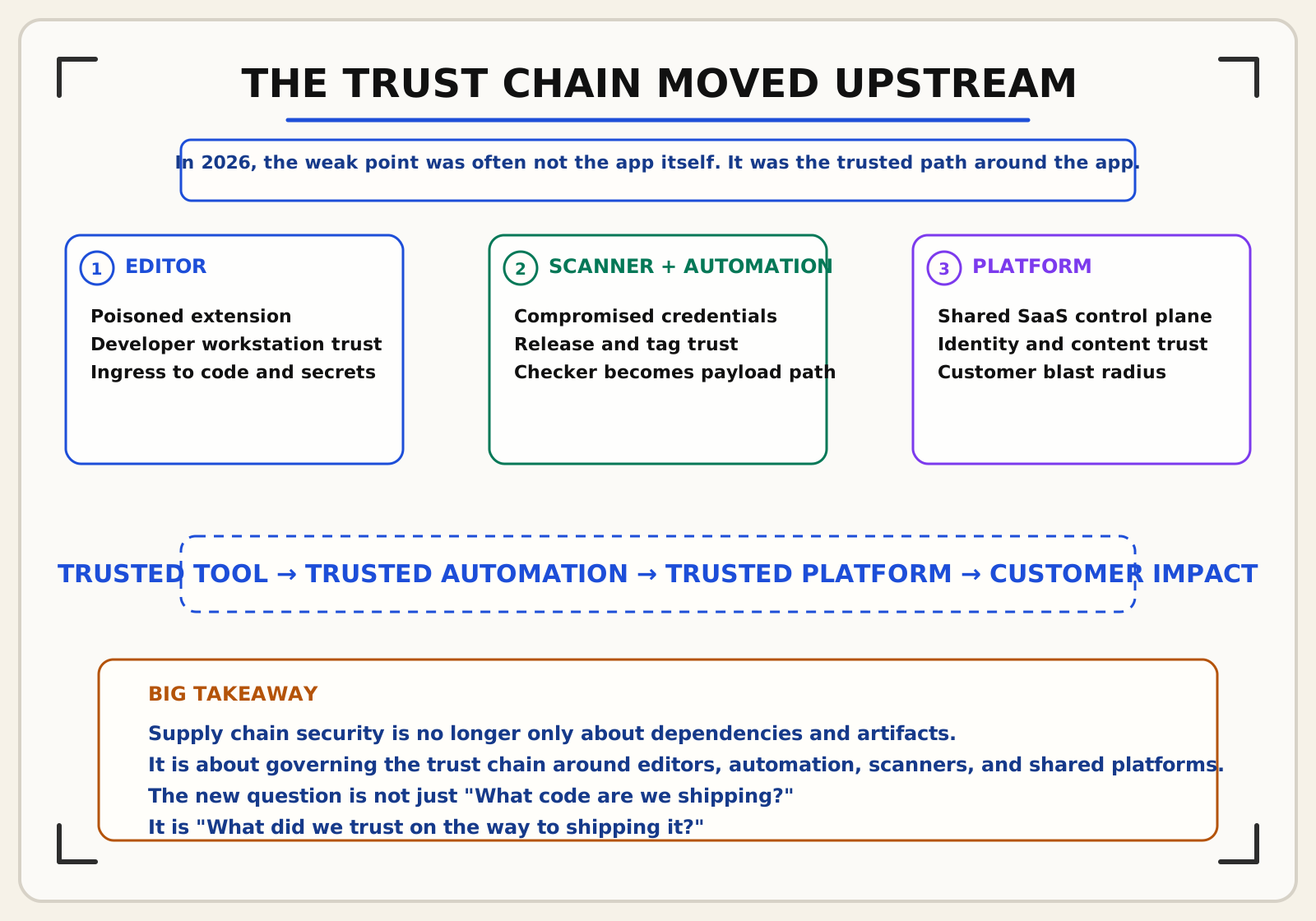
1. GitHub Showed That The Editor Can Be The Entry Point
In GitHub’s 20 May 2026 incident disclosure, updated 26 May 2026, the company said it detected and contained a compromise of an employee device involving a poisoned third-party VS Code extension. GitHub’s current assessment is that the attacker exfiltrated GitHub-internal repositories only, and that the attacker claim of roughly 3,800 repositories was directionally consistent with its investigation. GitHub also said it had no evidence of impact to customer repositories, though some internal repositories contained customer-related information such as support interaction excerpts. (GitHub)
The easy takeaway is “be careful with extensions.”
The more important takeaway is bigger than VS Code.
Developer tooling now sits inside the trusted operating path of the company. If you can compromise the environment where developers read, write, review, or ship code, you can often bypass the front door entirely.
That changes the security question from:
“Are we scanning our repositories?”
to:
“What are we trusting on the machine that touches our repositories?“
2. Trivy Showed That Security Tooling Can Become The Payload Path
In Aqua’s incident update, the company said that on 19 March 2026, a threat actor used compromised credentials to publish malicious releases of Trivy v0.69.4, as well as trivy-action and setup-trivy. Aqua later explained this was part of a broader multi-stage attack that began in late February, when attackers exploited a misconfiguration in Trivy’s GitHub Actions environment, extracted a privileged access token, and established a foothold in repository automation and release processes. (Aqua Security)
This is the part that should make engineering leaders uncomfortable.
Trivy is not just another package.
It is a security control.
When a scanner, action, or setup tool becomes compromised, the organisation is not only dealing with malicious code risk. It is dealing with a corrupted signal inside the place it goes to create assurance.
That means supply chain defence can no longer stop at “we run security tools.”
It has to ask:
- Who can publish those tools?
- What automation can retag or release them?
- What happens if the checker becomes the compromised component?
If your organisation has never rehearsed a “security tool compromise” scenario, that gap matters more now than it did six months ago.
3. Canvas Showed That The Platform Is Part Of The Supply Chain Too
Canvas is not a developer tool in the same way GitHub or Trivy are.
That is precisely why it belongs in the same conversation.
Instructure said it detected unauthorized activity in Canvas on 29 April 2026, then detected a second attack on 7 May 2026 in which the same threat actor gained additional access through a second Canvas vulnerability. Instructure said the actor made changes to pages shown to some logged-in students and teachers, and that it temporarily took Canvas offline into maintenance mode while investigating and containing the issue. The company later said the actor used one of its Free-For-Teacher accounts in both instances. (Instructure)
The lesson here is not “education software got breached.”
The lesson is that many organisations now rely on shared platforms as if they are background utilities, when in reality they are part of the trust chain.
If the platform controls identity, workflow, content, data access, or user experience, then compromise of that platform is not just a vendor issue.
It is an operating model issue for the customer too.
This is why security reviews that focus only on “does the vendor have a SOC 2?” are too shallow.
The real question is:
“What blast radius does this platform have if something goes wrong?”
What Actually Changed
The attack surface moved upstream.
For a long time, many software teams treated supply chain security as an artifact problem:
- scan the dependencies
- verify the container
- patch the vulnerability
- monitor the registry
That still matters.
But the 2026 pattern is broader than that.
The new trust chain looks more like this:
| Layer | Old mental model | New reality |
|---|---|---|
| Editor and workstation | Personal productivity tool | High-trust ingress point |
| CI and release automation | Convenience layer | Credential and provenance boundary |
| Scanner and setup actions | Safety mechanism | Attack path if publishing or tagging is compromised |
| Shared SaaS platform | Vendor service | Operational dependency with customer blast radius |
In other words, the question is no longer only:
“What code are we shipping?”
It is:
“What did we trust on the way to shipping it?”
The 10-Star Toolchain Test
A 5-star supply chain posture is one where the team has scanners, MFA, and a decent vendor questionnaire.
A 10-star posture feels different.
It assumes trusted surfaces can fail and designs around that fact.
| Toolchain question | Weak answer | Strong answer |
|---|---|---|
| Which editor extensions are allowed? | ”Developers pick what they need.” | Approved allowlist, monitoring, and fast revocation path. |
| How are automation tokens governed? | ”They live in CI secrets.” | Short-lived credentials, narrow scopes, rotation discipline, and usage review. |
| How are GitHub Actions and setup tools consumed? | ”We pin versions.” | Pin by commit SHA where possible, verify provenance, and track action ownership. |
| What happens if a security tool is compromised? | ”We would uninstall it.” | There is a documented response path, impact scope method, and rollback plan. |
| How are SaaS platforms tiered? | ”By spend and criticality.” | By blast radius across identity, data, workflow, and user trust. |
The difference between 5 stars and 10 is not more paperwork.
It is whether the team can answer the awkward question before the incident asks it for them.
What To Do In The Next 30 Days
If I were reviewing this posture with an engineering or security team now, I would start here:
1. Create an extension and developer-tool allowlist
Do not treat the local development environment as an unmanaged edge case.
2. Reclassify automation tokens by blast radius
PATs, release tokens, setup credentials, and GitHub Actions secrets should be governed like production access, not like build plumbing.
3. Pin and review third-party GitHub Actions and setup tools
Version tags are not enough if the release process or tags themselves can move.
4. Add one response playbook for “trusted tool compromise”
This should cover editors, scanners, setup actions, registries, package managers, and release automation.
5. Tier SaaS platforms by trust impact, not by procurement category
If the platform can influence identity, content, customer data, or a logged-in user experience, it belongs in a higher-risk tier.
6. Rehearse one ugly scenario
For example:
- the scanner is compromised
- a setup action is retagged
- an internal extension is poisoned
- a shared SaaS admin plane is abused
The point is not to create fear. It is to build fluency.
The Strategic Point
The supply chain story of 2026 is not that open source is unsafe.
It is that trust has become distributed across too many layers for old security models to keep treating “the application” as the only meaningful boundary.
Your developers trust tools. Your pipelines trust automation. Your operators trust platforms. Your customers trust the result.
That whole chain now needs governance.
The teams that adapt fastest will stop treating supply chain security as a dependency hygiene problem and start treating it as a toolchain trust problem.
That is the shift.
Related reading
- Resilience Engineering in the Cloud: Building Systems That Survive - the broader discipline of designing for failure instead of surprise.
- Architecting Cloud Native Systems on AWS and GCP - where trust boundaries and operational design become architecture decisions.
- MCP Tool Poisoning: The Attack Vector Nobody Is Talking About - the same trust-chain problem, applied to agents and tools.
Written by Haris Habib from Sydney, Australia | May 2026