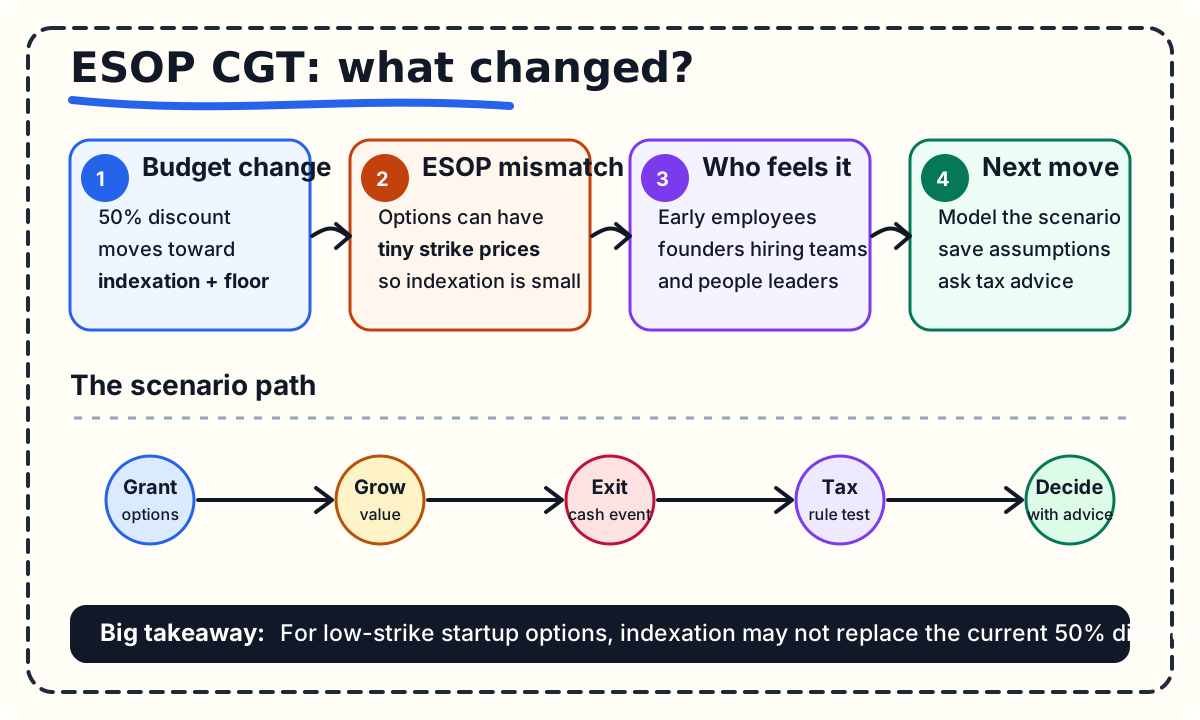
The Government has not simply put the old ESOP story back.
It has moved from “replace the 50% CGT discount for everyone” to “keep a 50% discount for a narrower class of innovative startup equity, if the tests are met.”
That is a backdown. It is not a full reversal.
When I wrote The 2026 Budget Changed the ESOP Question, the startup treatment was still unresolved.
The May 2026 Budget materials said the Government would replace the 50% Capital Gains Tax discount with cost-base indexation and a 30% minimum tax rate from 1 July 2027. They also said the Government would consult on how the reforms interacted with early-stage and startup-business incentives.
That consultation has now become more concrete.
On 18 June 2026, Treasury opened consultation on a proposed Innovative Business CGT Concession, or IBCC. Submissions close on 10 July 2026.
The important part for ESOP holders is this: Treasury now proposes a targeted 50% discount for eligible early investment in qualifying innovative startups, including founders, employee share scheme participants, employee share option plan participants, early-stage investors, and certain venture-capital general partners.
That means the Government appears to have accepted the core startup objection:
Indexation is a weak substitute when the cost base is very low or zero.
That was exactly the practical problem for many startup options.
But the proposed fix is not “everyone gets the old rules back.”
It is a new gate.
What changed
The original Budget position was broad.
From 1 July 2027, the 50% CGT discount would be replaced with indexation and a 30% minimum tax rate for individuals, trusts, and partnerships. The official Budget explainer said the reform would apply broadly to CGT assets, including property and shares, while preserving existing treatment for gains accrued before 1 July 2027.
For startup employees, that created a problem.
If your option strike price is tiny, there is not much cost base to index. A $1,000 exercise cost indexed for several years does not behave like a 50% discount on a large exit gain.
Treasury’s 18 June consultation paper now says the proposed IBCC would let eligible shareholders choose between:
| Path | Directional treatment |
|---|---|
| IBCC path | 50% discount on nominal capital gains for eligible startup shares and options |
| General proposed path | Cost-base indexation plus the 30% minimum tax framework |
That is the key shift.
For qualifying startup equity, the 50% discount may survive.
What did not change
The broader CGT reform has not been abandoned.
The Government is still pursuing the main Budget architecture: indexation, a 30% minimum tax, and transitional treatment for gains before 1 July 2027.
The startup response is a carve-out, not a repeal.
That matters because carve-outs create boundary questions:
- Is the company young enough?
- Is the turnover low enough?
- Is it actually “innovative” under the proposed principles?
- Was the equity issued at the right time?
- Has the holder met the minimum holding period?
- Is the company excluded because of its predominant activity?
- Does the lifetime cap matter?
The old simplified employee question was:
Have I held long enough for the 50% CGT discount?
The new question is:
Does my grant qualify for the IBCC?
That is a very different kind of uncertainty.
The proposed IBCC gate
Based on Treasury’s consultation paper, the proposed concession would broadly work like this.
For new shares issued after 30 June 2027, eligible shares would need to be:
- new equity issued by an unlisted and independent company
- issued while the company has annual turnover below $50 million
- issued while the company is generally less than 10 years old
- issued by an active, innovative startup
- held by the taxpayer for at least five years
Treasury is also considering a longer 15-year age limit for sectors such as biotech, medtech, and deep tech where commercialisation takes longer.
For existing shares issued before 1 July 2027, transitional arrangements are proposed. The company would generally need to be an unlisted, independent, innovative startup that is less than 10 years old on 30 June 2027 and had turnover under $50 million in the 2025-26 income year. The shares would still need to be new equity and held for at least five years at disposal.
There is also a proposed $10 million lifetime cap on total gains per individual receiving the concessional treatment.
This is why the answer is “medium,” not “old rules restored.”
The Government has shifted toward the startup ecosystem, but it has not returned to a broad, simple, asset-wide 50% discount.
The innovation test is now the centre of gravity
The consultation paper borrows principles from the existing Early Stage Innovation Company framework.
The company would need to show it is genuinely focused on developing new or significantly improved innovations for commercialisation, has high growth potential, can scale, can address a broader than local market, and has competitive advantages.
That sounds reasonable at policy level.
In practice, it creates a documentation problem.
If you are a founder, this is no longer just a tax-model question. It becomes an evidence question:
- Can you show the business plan?
- Can you show the commercialisation strategy?
- Can you show the market is broader than local?
- Can you show competitive advantage?
- Can you show the company was innovative at the relevant point in time?
If you are an employee, the uncomfortable part is that you may not control any of that evidence.
You hold the options.
The company holds the proof.
That is where the new policy could still fail the practical ESOP test. A concession that technically exists but is hard for employees to verify may still be discounted heavily in offer conversations.
What founders should change now
Founders should not promise that every grant is safe.
But they can stop treating this as a vague future tax issue.
The practical work is:
- Map existing grants by issue date, holder type, plan type, and likely ESS treatment.
- Check whether the company would satisfy the proposed age and turnover thresholds.
- Start preparing evidence for the innovation principles.
- Identify whether any business activity could be excluded.
- Model the five-year holding period against realistic exit and liquidity scenarios.
- Prepare an employee-facing note that says what is known, what is not known, and who should get personal advice.
That last point matters.
This is not about founders giving tax advice. They should not.
It is about making sure the company is not selling a compensation story it cannot explain.
What employees should change now
Employees should not read the 18 June paper as “problem solved.”
It is better than the first version, but it is still conditional.
If you hold options or shares, the better questions are now:
| Question | Why it matters |
|---|---|
| Was my equity issued as new equity? | The proposed IBCC is aimed at eligible new equity. |
| How old was the company when the equity was issued? | The general age test is 10 years, with possible sector-specific extensions. |
| What was the company’s turnover at the relevant time? | The proposed turnover threshold is $50 million. |
| Would the company satisfy the innovation principles? | The concession depends on active, innovative startup status. |
| How long will I have held the shares at disposal? | The proposed minimum holding period is five years. |
| Does my company have documentation it can share or summarise? | Employees need evidence, not vibes. |
| What should I ask my accountant, registered tax agent, or lawyer? | Personal circumstances can change the answer. |
Use the ESOP CGT Explorer as a directional conversation starter, not as an answer.
The calculator already compares the original Budget proposal against the current 50% discount model. It now needs to be updated to reflect the actual 18 June IBCC design more precisely: qualifying innovative startup equity may get a 50% discount without the 30% minimum tax, while non-qualifying equity remains exposed to indexation and the minimum tax path.
My read
Yes, the Government has backed down from the cleanest version of the May Budget proposal as it would apply to startups.
But no, it has not simply restored the old world.
The likely direction is a middle model:
- broad CGT reform remains
- small business active-asset relief is expanded
- innovative startup equity gets a targeted 50% discount pathway
- eligibility becomes the new battleground
- employees need company-level evidence to understand their own position
That is better than the original proposal for many startup employees.
It is also more complex.
The ESOP story has changed again:
The 50% discount may survive for qualifying startup equity, but the hard part moves from arithmetic to eligibility.
That is the blog post. That is the calculator update. And that is the next conversation founders need to have with their teams.
Sources and further reading
- Treasury consultation: Capital gains tax reforms - arrangements for innovative start-ups
- Treasury consultation paper: Capital gains tax reforms - arrangements for innovative start-ups
- Budget 2026-27: Tax reform
- Budget 2026-27 tax explainer: Negative Gearing and Capital Gains Tax Reform
- The Guardian: Albanese announces capital gains tax exemptions after budget backlash
- ESOP CGT Explorer