This is not a tax post. It is a talent post wearing a tax-shaped coat.
If you are an Australian startup founder, the proposed CGT reform is about to walk into your next offer letter, your next retention conversation, and your next board update.
And if you are not modelling it yet, your employees already are.
On 12 May 2026, the Federal Budget proposed replacing the 50% Capital Gains Tax discount with CPI indexation and a 30% minimum tax rate from 1 July 2027.
I wrote the employee-facing version of this in May. That piece walked through what the change means for someone holding startup options — and I built a free calculator so ESOP holders could run their own numbers.
You can read that here: The 2026 Budget Changed the ESOP Question.
This piece is different.
This is for you — the founder who has to keep a team together while the compensation story shifts underneath you.
The problem is not the tax rate. It is the story.
Here is what happens when an employee reads about the CGT reform:
They do not pull up the Budget explainer.
They see a headline. They ask a colleague. They multiply their option count by a sale price they made up, then halve it, then wonder whether the whole thing is worth less than they thought.
And most of them will not ask you directly.
They will ask each other. They will sit on it. And at the next one-on-one, when you ask whether they are still bought in, they will say yes — but the discount they apply to their own equity just got larger.
That is the real cost of this reform for founders.
Not the tax line item.
The widening gap between what you think your equity is worth to your team and what your team thinks it is worth.
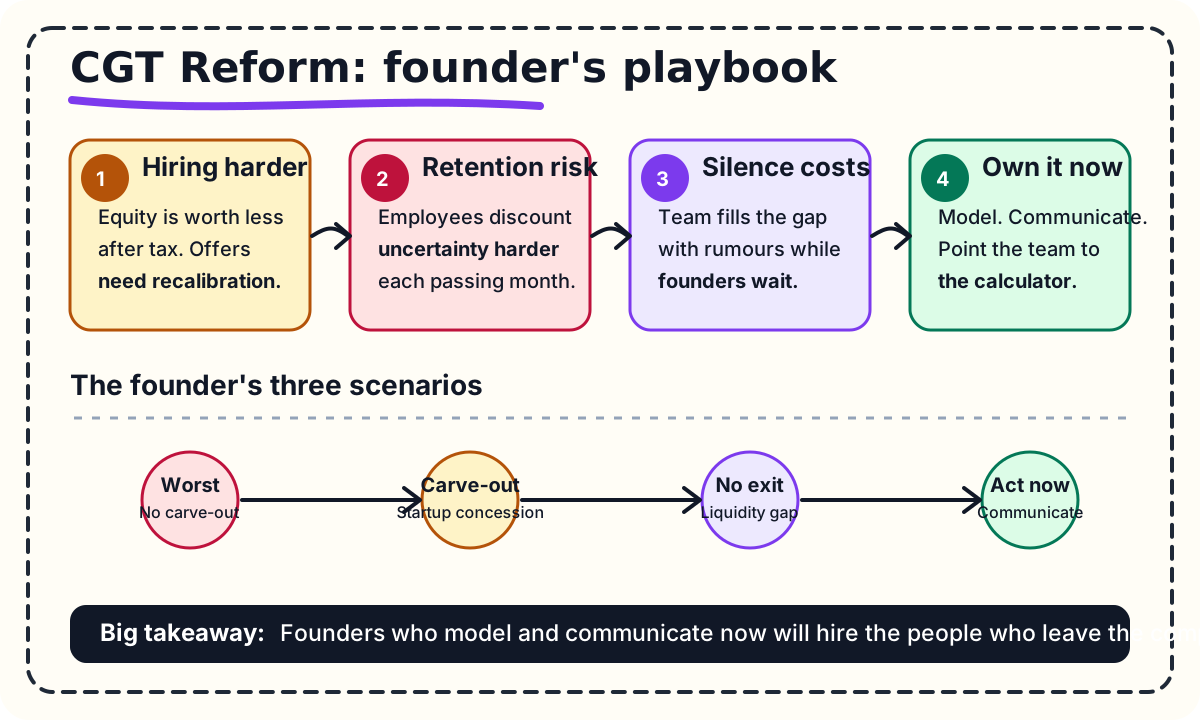
Three founder problems the reform creates
1. Hiring just got harder to price
Every Australian startup offer has two parts: cash and equity.
For the last decade, the equity pitch was straightforward:
Hold the shares long enough, take the risk, and the tax treatment is meaningfully better than salary.
Under the proposed rules, that story weakens.
If your early employee exercises at $0.10 and sells at $5.00, the current 50% discount roughly halves the taxable gain. Under indexation, a $1,000 cost base indexed at 2.5% for four years becomes about $1,104. The taxable gain barely moves.
That means the after-tax outcome for your employee shrinks — and the equity portion of your offer shrinks with it.
Founders who do not model this will lose candidates to companies that do.
2. Retention is now an information problem
Your employees are holding something illiquid that they cannot price.
Before, the mental model was fuzzy but directionally stable: hold, wait, get better tax treatment.
Now the mental model is: hold, wait, get a tax outcome nobody can explain yet.
Uncertainty is not neutral. It compounds.
Every month between now and July 2027, employees who do not understand their exposure will discount their equity harder. That discount shows up as:
- Lower engagement in long-term planning
- Higher openness to recruiters
- Exercise paralysis (“I will wait until I know the rules”)
- Quiet resentment if the company does not address it
The retention risk is not that people leave tomorrow. It is that they mentally leave and stay.
3. Communication is your lever — and most founders are not pulling it
I have talked to enough founders in the last few weeks to know the pattern:
- “We are waiting until the legislation is final.”
- “We do not want to alarm people.”
- “It might not even pass.”
That instinct is understandable. It is also wrong.
Your team already knows something is happening. They saw the Budget coverage. They heard about Dashdot collapsing — 40 jobs gone, the founder directly blaming the CGT changes. They are reading the Coalition’s startup campaign statements. They have seen Ed Husic trying to calm the market.
If you are silent, you are not keeping them calm. You are leaving them alone with Google.
The founders who communicate now — even if all they say is “here is what we know, here is what we do not know, and here is how we are thinking about it” — will retain more trust than the ones who wait for certainty that may not arrive until late 2027.
What every founder should model
You do not need a PhD in tax policy. You need three scenarios and a conversation.
Scenario 1: The worst reasonable case
Assume the reform passes as proposed. No startup carve-out. Indexation replaces the 50% discount. Minimum 30% tax applies.
Model what happens to:
- Your earliest employees (lowest strike prices, most exposed)
- Your standard grant sizes at each level
- Your most recent hires (highest strike prices, least exposed — but also least bought in)
The question: at what exit price does the equity still feel valuable after tax?
Scenario 2: The carve-out case
Assume consultation produces a startup-specific concession. Maybe holding-period based. Maybe a modified discount for ESS-qualifying schemes. Maybe transitional treatment for pre-2027 grants.
Model what changes. More importantly: identify which of your current grants would qualify and which would not.
Scenario 3: No exit in sight
This is the hardest one — and the one most founders avoid.
If your next liquidity event is 3+ years away, your employees are holding equity through an unknown tax regime with no near-term path to cash.
Model: what would it take to create a partial liquidity event before July 2027? A secondary sale? A tender offer? Even a small one changes the psychology.
The tool you can point your team to
I built the ExitLens ESOP CGT Explorer so employees could run their own numbers without having to reverse-engineer Budget documents.
It is free. It runs in a browser. Nothing is stored or sent anywhere.
It compares three simplified outcomes:
- Baseline (sell without the 50% discount)
- Today’s rules (hold 12+ months, get the 50% discount)
- Proposed rules (indexation + 30% minimum tax from July 2027)
It is deliberately not a full tax model. It does not replace an accountant, tax agent, lawyer, or financial adviser.
But it takes the abstract policy debate and turns it into a number your employee can look at — and then take to someone qualified.
Founders: do not just forward the link. Run your own grant sizes through it first. Know what your employees will see before they see it.
The questions founders should be asking this week
| Question | Why it matters |
|---|---|
| Do our offer letters explain equity in plain English? | If employees do not understand what they hold, they will not value it. |
| Do our employees know whether their grants qualify for the startup concession? | Standard ESS, deferred ESS, and startup concession outcomes are different. |
| What is the lowest strike price across our cap table? | These are the people most exposed to indexation being a weak substitute. |
| What would a partial liquidity event before July 2027 cost us? | Even a small one may be worth modelling. |
| Who owns the equity communication plan? | If nobody owns it, you own it by default. |
| Have we briefed our investors? | Your board should understand the talent risk, not just the tax policy. |
What not to do
Do not wait for final legislation
The 2026-27 Budget measures are proposed, not law. The ESOP interaction is under consultation. The Senate inquiry is still open.
Waiting for certainty is waiting for a date that might be years away — during which your employees are making career decisions with incomplete information.
Start communicating now. Update as you go.
Do not give tax advice
This should be obvious. But I have already heard founders say things like “don’t worry, the startup concession will protect you.”
You do not know that. I do not know that. No one knows that.
The right thing to say: “Here is what we understand. Here is the tool we recommend you use as a starting point. Take your scenario to a qualified adviser before making decisions.”
Do not assume your team is fine because nobody has asked
The dangerous conversations are the ones that are not happening.
If nobody on your team has brought up the CGT reform, it is not because they do not care. It is because they do not know how to start the conversation — or they think you do not want to have it.
Create the space. Send the email. Put it on the all-hands agenda.
Do not make promises you cannot keep
Do not tell employees their grants will be grandfathered. Do not promise a carve-out that does not exist. Do not guarantee a secondary sale you have not priced.
The trust you build now by being honest about uncertainty is worth more than the short-term comfort of false certainty.
The real founder question
The policy question is:
Will the Government carve out startups from the CGT reform?
The founder question — the one that matters to your company — is different:
Can I keep my team believing in the upside while the rules change underneath us?
That is not a tax question. It is a leadership question dressed in tax language.
And the founders who answer it well will hire the people who left the companies that did not.
Try the calculator
Start here:
Run a scenario for your earliest employees. Run one for your most recent hire. Then send it to your team with a note that says:
“Here is a starting point. Run your own numbers. Then let us talk about what you see.”
That conversation is worth more than any Budget submission.
Sources and further reading
- Budget 2026-27: Tax reform
- Budget 2026-27 tax explainer: Negative Gearing and Capital Gains Tax Reform
- Treasury: Employee share schemes
- ATO: Key ESS changes in detail
- Baker McKenzie: Australia Budget Bites
Related reading
- The 2026 Budget Changed the ESOP Question — the employee-facing companion piece
- Australia’s Company Formation Drain
- Australia’s Startup Opportunity Map