August set a record for global venture funding.
It was also a slowdown.
Both statements come from the same data set, and the fact that they can coexist without contradiction is the most useful thing an Australian founder can take from the current market.
The headline, and the line underneath it
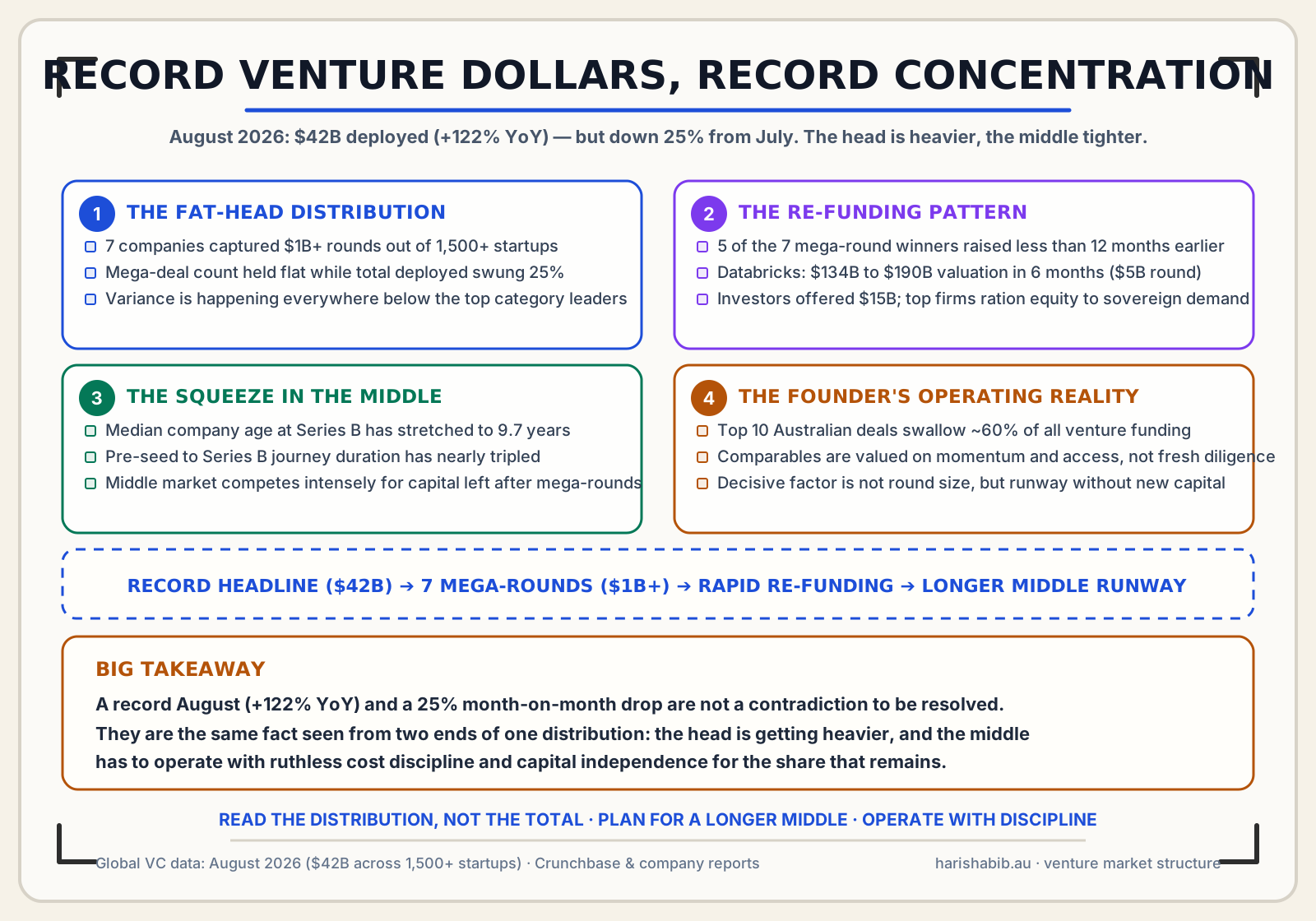
The August numbers: venture investors deployed $42 billion into just over 1,500 startups worldwide. That is up 122% on August 2025, which is typically a slower month for startup investment.
Now the second number, the one that rarely makes the headline. It is down 25% from July’s $56 billion.
A record August that is also a month-on-month decline. Most coverage led with the 122%, because it is the more dramatic figure and the one that flatters the market. But the decline is not noise, and it is not a rounding artefact. It is how you tell the difference between a market that is broadly expanding and a market that is concentrating.
Where the money actually went
Here is the shape of it.
August produced seven billion-dollar funding rounds — tied for the second-highest monthly count of the year, behind July’s thirteen. Which tells you something structural. The total moved 25% in a month. The number of mega-rounds barely moved at all. Both July and August were, in effect, “a handful of billion-dollar deals.”
So if the totals are swinging while the count of very large rounds stays stable, the variation is not happening at the top. It is happening everywhere below it.
Seven companies, out of more than 1,500. That is not a distribution with a fat tail. That is a distribution with a fat head.
The re-funding pattern
Then there is the detail that should reframe how anyone raising right now reads this market.
Five of those seven billion-dollar recipients had last raised capital less than 12 months earlier. Three of them had closed their previous round earlier in the same year.
The natural assumption is that a record month means new capital is finding new companies. Mostly, it is not. It is capital re-entering companies that investors already back, faster and at higher prices, because those are the deals available and the demand to be in them is not satisfied.
That is not a finding about ambition. It is a finding about allocation.
Databricks is not the outlier. It is the ceiling.
The month’s largest round was Databricks: $5 billion at a $190 billion valuation, led by Coatue alongside Blackstone, MGX, T. Rowe Price and Sixth Street Growth.
Six months earlier, Databricks was valued at $134 billion. That is a $56 billion increase in half a year. The company also crossed a $7 billion revenue run-rate, growing more than 80% year on year. On the merits this is an exceptional business, and the round is not irrational.
But here is the part worth sitting with. According to reporting on the deal, Databricks went out wanting to raise $1 billion. Investors wanted $15 billion. It settled at $5 billion.
A company had to ration access to its own equity. Demand for the top of this market is running so far ahead of supply that the binding constraint is no longer whether investors will fund it — it is how much the company will let them.
Read that next to “five of seven had raised within the last year” and the picture becomes coherent. The best-positioned companies are being funded repeatedly and heavily, and their rounds are sized by what the company will accept rather than by what the market will provide.
Two more transactions, for contrast
Two other August events belong in the same frame.
Nvidia agreed to acquire Hugging Face for $12.9 billion. Bending Spoons agreed to acquire Airtable for around $1.3 billion. On the Shanghai Stock Exchange, Unitree Robotics listed and rose 460% on its first day.
A nine-year-old open-source platform absorbed at a price that values ecosystem and distribution. A thirteen-year-old category-defining SaaS company changing hands for less than a tenth of that. A robotics listing that nearly quintupled on day one.
The public and private markets are not sending one signal. They are sending several, at volume.
The Australian read
None of this is new. It is simply larger.
In Australia’s AI Incubator Problem, I looked at local data showing the top ten deals accounting for almost 60% of capital raised — capital available, but concentrated around fewer high-conviction companies. In Australia’s Company-Formation Drain, the median company age at Series B had stretched to 9.7 years, and the path from pre-seed to Series B had nearly tripled since 2021.
August’s global numbers are the same pattern at a different scale. Concentration does not need an Australian version and a global version, because it is one phenomenon wearing different local accents. And the practical consequence is identical in both: the market you experience is not the market in the headline.
If you are raising at the top of your category, with traction and a story that fits the AI narrative, capital is not your constraint. If you are raising in the middle — a good business, real revenue, no obvious category ownership — you are competing for the share of the $42 billion that is left after the seven.
What to do with this
Three things, none of them about headline totals.
Read the distribution, not the total. An aggregate number is a marketing asset. The shape of it is decision-useful. Ask where the deals went, at which stage, and how many companies actually received them.
Treat re-funding as a signal about your comparables. When five of seven mega-rounds go to companies that raised less than a year ago, the “hot” private companies in your space are not being valued on fresh diligence. They are being valued on momentum and access. It matters which of those you are being measured against.
Plan for a longer middle. If the scale-up path keeps stretching, the thing that decides your outcome is not the size of your next round. It is how long you can operate without it. That is a cost-structure question and a discipline question, and it is the part of this market you actually control.
The close
A record August and a 25% decline are not a contradiction to be resolved. They are the same fact viewed from opposite ends of one distribution — a market where the head is getting heavier, and the middle has to run harder for the share that remains.
Both readings of this market are correct. That is exactly why you have to know which part of it you are standing in.