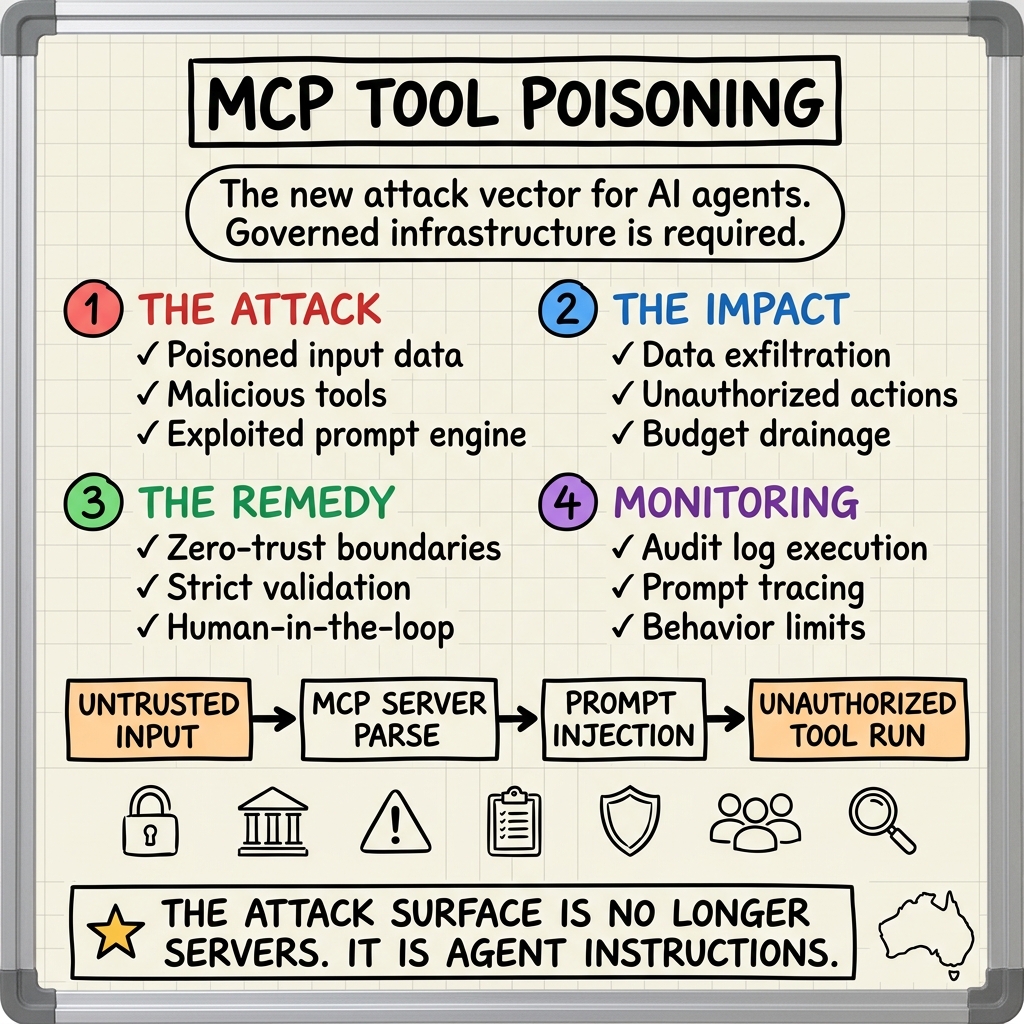
The shift.
Traditional security protects servers.
Agent security protects instructions.
Most teams are only doing the first one.
What Is MCP Tool Poisoning?
The Model Context Protocol (MCP) is how AI agents connect to tools — databases, APIs, file systems, external services.
An agent with access to MCP tools can read, write, summarise, and execute on your behalf.
MCP tool poisoning is what happens when a malicious MCP server injects hidden instructions into the tool’s responses — instructions that look like legitimate data but redirect the agent’s behaviour.
     NORMAL FLOW:
     User → Agent → MCP Tool → Legitimate Response → Action

     POISONED FLOW:
     User → Agent → Malicious MCP Tool → Injected Instructions
                                              ↓
                                       Agent executes
                                       attacker's intent
                                       while appearing normal
The agent does not know it has been compromised.
The user sees normal-looking output.
The damage is already done.
1. Why This Is Different From Traditional Attacks
| Traditional Attack | MCP Tool Poisoning |
|---|---|
| Targets infrastructure | Targets agent reasoning |
| Visible in logs | Often invisible until post-incident |
| Blocked by perimeter security | Bypasses firewalls entirely |
| Requires code execution | Requires only a malicious instruction |
| Fixed by patching software | Fixed by governing trust |
The threat model has changed.
When your AI agent is the attack surface, your WAF and your SIEM are not enough.
2. The Enterprise Gap
Every major enterprise agent deployment right now has the same problem:
- Agents are connected to dozens of MCP tools
- No agent-level identity or authorisation registry
- Tool responses are trusted by default
- There is no deterministic guardrail on what an agent can be instructed to do
The Salesforce “trusted gateway” model is one emerging response. Microsoft Agent 365 shipped an agent registry before it shipped full autonomy. These are signals.
This is not theoretical. Several critical vulnerabilities have already been disclosed:
- CVE-2025-32711 (EchoLeak): A zero-click indirect prompt injection flaw in Microsoft 365 Copilot that allowed data exfiltration from connected services (SharePoint, Outlook, OneDrive) via poisoned context.
- CVE-2025-46059: An indirect prompt injection vulnerability in LangChain’s GmailToolkit that allowed arbitrary code execution via crafted email messages.
- CVE-2025-54073: Command injection in the
mcp-package-docsserver due to unsanitized input parameters, leading to potential remote code execution.
Most teams building on LangChain, AutoGen, CrewAI, or Claude Code are still wiring tools directly with no poisoning protection.
3. What Zero-Trust for Agents Looks Like
Zero-trust for networks says: never trust, always verify.
Zero-trust for agents says the same thing, but about instructions:
| Layer | What It Does |
|---|---|
| Agent Identity Registry | Every agent instance has a verified, revocable identity |
| Tool Allowlist | Agents can only connect to explicitly approved MCP servers |
| Instruction Validation | Responses from tools are checked before the agent acts on them |
| Execution Audit Trail | Every tool call, every response, every action is logged immutably |
| Human Approval Gates | Irreversible actions require human sign-off before execution |
| Anomaly Detection | Unusual patterns in agent behaviour trigger review, not just alerts |
This is not science fiction. It is the same pattern as zero-trust networking, applied to the agentic layer.
4. Regulated Industries Are Exposed First
The sectors with the most autonomous agent deployment are also the sectors with the strictest compliance requirements:
| Sector | Agents Being Deployed | Compliance Risk |
|---|---|---|
| Financial services | Transaction monitoring, fraud detection | AUSTRAC, APRA, ASIC |
| Legal / compliance | Document review, regulatory filing | Professional liability |
| Healthcare | Clinical decision support, admin automation | Privacy Act, TGA |
| Government | Benefits processing, permit systems | APS standards |
An agent that files a suspicious matter report with AUSTRAC after being poisoned by a malicious tool is not just a security incident.
It is a compliance failure with criminal liability attached.
5. The Product Gap
     CURRENT STATE                  NEEDED STATE
     ─────────────                  ────────────
     Tools trusted by default   →   Tools verified by identity
     No agent registry          →   Centralised agent registry
     Logs optional              →   Append-only mandatory logs
     Autonomy before governance →   Governance before autonomy
     Post-incident detection    →   Pre-execution validation
The companies that build this infrastructure — not as an add-on, but as the first layer — will own enterprise agent deployment in regulated industries.
The Five Eyes AI guidance already signals the direction: incremental deployment, human oversight, low-risk starting points, monitoring, continuous reassessment.
Translation: provable constraint beats maximum autonomy.
The Big Takeaway
The attack surface for enterprise AI is not your servers anymore. It is your agents’ instructions.
Perimeter security does not defend against a poisoned tool response.
Zero-trust for agents is not optional in regulated industries — it is the only compliant architecture.
The companies racing toward maximum agent autonomy will face this problem at the worst possible moment: during an incident.
Build the governance layer first.
The autonomy can follow.
Related reading
- Who Signs the Contract When Your AI Agent Does It? — the identity layer that poisoning defeats.
- I Gave an AI Agent the Keys to My Life. Here Is the Trust Architecture. — the same zero-trust pattern, applied to a personal agent.
- One Model Is the Wrong Default — why provable constraint beats raw capability.
- The 10-Star Experience: Why Product and Engineering Need Legendary Test Cases — how we map zero-trust boundaries into a legendary experience.
Written by Haris Habib from Sydney, Australia | May 2026