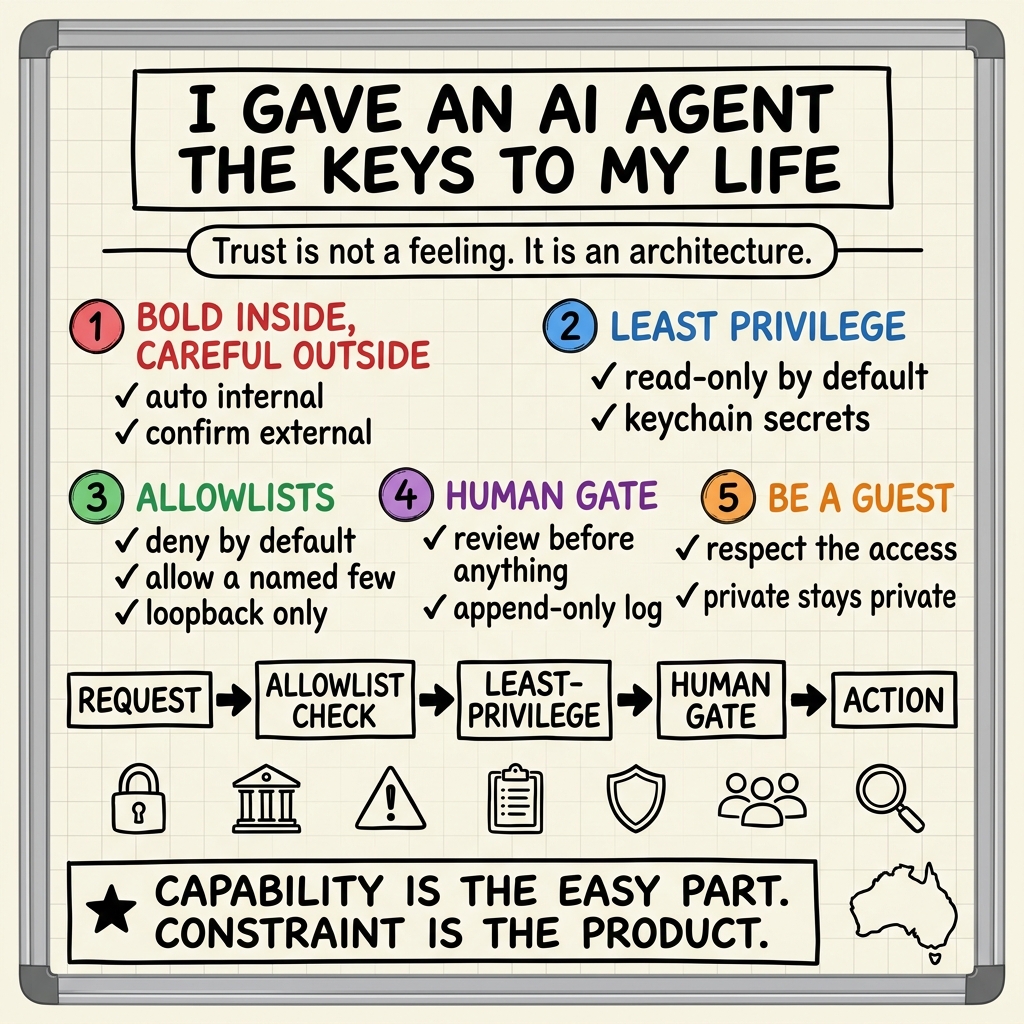
The deal. The agent can touch my email, calendar, files, and chats. That is a lot of trust for software. Trust is not a feeling here. It is an architecture.
The Uncomfortable Setup
My personal AI agent has access to my inbox, my calendar, my files, my task boards, and my messaging accounts. It runs scheduled jobs while I sleep and reports back in the morning.
Said plainly, that sounds reckless. I have handed an autonomous system the keys to my digital life.
The reason I sleep fine is that the access is wrapped in boundaries I designed before I granted any of it. The agent is powerful inside a cage I built. The cage is the product. The intelligence is just what lives in it.
Here is the architecture — five layers, each one a deliberate constraint.
1. Bold Inside, Careful Outside
The single most important rule my agent follows is a split:
Be bold with internal actions. Be careful with external ones.
Reading my files, organising notes, searching, summarising, learning — go ahead, no permission needed. These are reversible and private.
Sending an email, posting a message, anything other people will see — stop and confirm. These are irreversible and public.
     INTERNAL (reversible, private)    EXTERNAL (irreversible, public)
     ──────────────────────────       ───────────────────────────────
     Read files            ✓ auto      Send email          ⚠ confirm
     Search & summarise    ✓ auto      Post to a chat      ⚠ confirm
     Organise / draft      ✓ auto      Run public actions  ⚠ confirm
     Update its own memory ✓ auto      Anything others see ⚠ confirm
Most agent disasters happen on the external side — the message sent to the wrong person, the half-baked reply fired off automatically. Drawing the line here is where 90% of the safety comes from.
2. Least Privilege, Always
The agent never gets more access than the task in front of it requires.
When it reads Google services, it requests read-only scopes unless a write is genuinely needed. Credentials are stored in the OS keychain, not in plain text. Each integration is authorised separately, so a problem with one never cascades into all of them.
This is the same principle that governs good cloud security — request the narrowest permission that gets the job done. It is unglamorous, and it is the difference between “a bug” and “a breach.”
3. Allowlists, Not Open Doors
An autonomous agent connected to the open internet is an attack surface. So almost nothing about mine is open by default.
| Surface | Default | Policy |
|---|---|---|
| Who can message it | Denied | Allowlist of approved accounts only |
| Which commands it can run | Denied | Explicit command allowlist |
| Which channels it listens on | Denied | Named, configured channels only |
| Network exposure | Loopback | Runs on localhost, not a public port |
The agent does not listen to the whole world and filter out the bad actors. It listens to no one and lets in a named few. That inversion — deny by default, allow by exception — is the whole game.
4. A Human Gate on Anything Irreversible
For any action that cannot be undone, there is a review point before execution.
This is the same pattern I have argued for in regulated AI: a human-in-the-loop gate before irreversible actions, and an append-only log of what the agent did so there is always an answer to “what happened and why?”
A capable agent without these is just risk with good output. The gate is not friction — it is the thing that lets you grant the access at all.
5. Treat the Agent as a Guest
The last layer is not technical. It is a posture written into the agent’s instructions:
You have access to someone’s life — their messages, files, calendar. That is intimacy. Treat it with respect. Private things stay private. When in doubt, ask before acting externally.
It sounds soft. It changes real behaviour. An agent that is told it is a guest in someone’s home defaults to caution at exactly the moments a more eager system would barge ahead. You are shaping judgement, not just permissions.
Why This Matters Beyond Personal Agents
Everything above scales straight up to the enterprise question every regulated business is now facing: how do we let agents act without losing control?
     PERSONAL AGENT              ENTERPRISE AGENT
     ──────────────             ────────────────
     Allowlist of accounts   →  Agent identity registry
     Command allowlist       →  Tool / action allowlist
     Confirm before external →  Human approval gates
     Local, least-privilege  →  Scoped, auditable access
     "Be a guest"            →  Governance before autonomy
The personal version and the enterprise version are the same architecture at different scales. Get it right on one machine for one person, and you understand exactly what APRA, AUSTRAC, and every CISO are going to demand of agents at scale.
The Big Takeaway
Capability is the easy part. Constraint is the product. I did not make my agent safe by making it less capable. I made it safe by deciding, in advance, what it is allowed to do without asking.
You can absolutely give an AI agent the keys to your life.
Just build the locks first.
Related reading
- Your AI Agent Needs a Soul File — what the agent remembers.
- One Model Is the Wrong Default — how it decides which model does the work.
- Who Signs the Contract When Your AI Agent Does It? — the same controls, in a regulated setting.
- The 10-Star Experience: Why Product and Engineering Need Legendary Test Cases — how we build resilient-by-default pathways for personal trust.
Written by Haris Habib from Sydney, Australia | May 2026