If you work in a startup and part of your upside is options, this is not abstract.
It is the difference between “this could change my life” and “I do not know what I actually keep.”
I care about this because I am one of those startup employees too.
I built a small tool for this because the policy discussion was getting abstract too quickly, while the employee version of the question is painfully practical:
If the company wins, what happens to my options after tax?
You can try it here:
It is free. It runs in your browser.
Important disclaimer: this article and the ESOP CGT Explorer are for education and awareness only. They are not tax advice, financial advice, accounting advice, legal advice, or a recommendation to exercise, sell, hold, or restructure equity. As at 31 May 2026, this is a fluid situation: the Budget measures are proposed, consultation is underway, the ESOP interaction is not settled, and the final law or administrative guidance may change. If the Government changes the rules, this article and the calculator assumptions will need to be updated. The simplified modelling may not be 100% accurate for your circumstances. For actual advice, speak with your accountant, registered tax agent, lawyer, or appropriately qualified financial adviser before acting.
But it makes the shape of the problem visible.
The proposed 2026-27 Budget change is not just a property-tax story. For startup employees, it may change the after-tax reward attached to options or shares under an ESOP or employee share scheme.
That matters because startup equity is not a normal investment.
It is illiquid. It is risky. It often cannot be sold when the employee wants. It can expire worthless. And for employees, especially early employees, equity is usually part of the bargain: accept uncertainty, help build the company, and if the company wins, share in the upside.
That is not just a spreadsheet line. It affects how people think about joining, staying, exercising, and believing the compensation story.
The 2026 Budget puts pressure on that bargain.
What the Budget proposed
The Federal Budget was handed down on 12 May 2026.
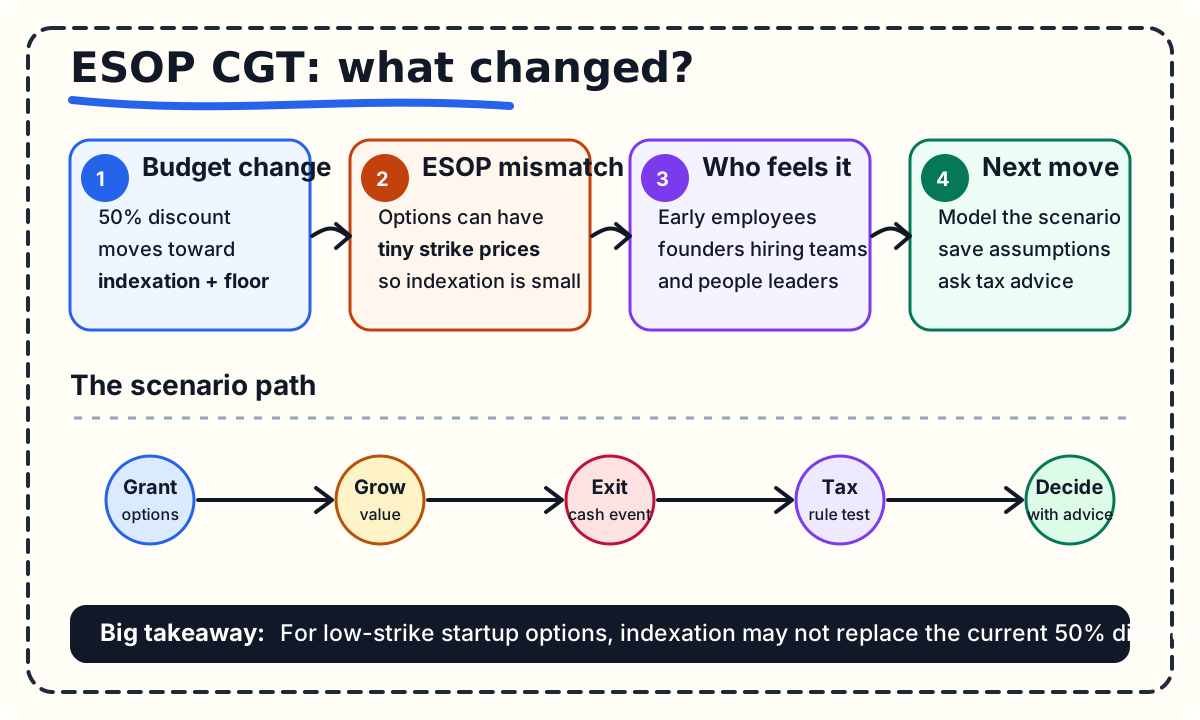
In the tax reform materials, the Government says it will replace the 50% Capital Gains Tax discount with an inflation-based discount and introduce a 30% minimum tax on gains from 1 July 2027.
The official Budget explainer says the reform will:
- reintroduce cost base indexation
- apply a 30% minimum tax rate on capital gains
- apply the new arrangements from 1 July 2027
- apply only to gains accruing after 1 July 2027
- use transitional rules for assets already owned before that date
The important detail for the startup world is buried deeper in the explainer: the Government says it will consult on how the CGT reforms interact with early-stage and startup-business incentives.
That means the ESOP outcome is not fully settled.
This article is deliberately timely, not final. It captures the issue as it stands now so employees, founders, people teams, and advisers can start asking better questions. If consultation produces different treatment for ESOPs, startup concessions, transitional gains, or cost-base indexation, the analysis will need to change.
But the issue is live enough that startup employees like me, plus founders, people teams, and advisers, should be modelling the exposure now.
Why ESOPs are different
In Australia, the legal language is usually employee share scheme or ESS. People often say ESOP when they mean options or equity issued to employees by a startup.
The reason the startup concession matters is simple.
For qualifying schemes, an employee can often avoid upfront income tax on the discount and be taxed later under the CGT rules when the interest or resulting shares are disposed of.
That is a very different experience from being taxed as ordinary income before you have cash.
For employees, this matters because startup equity can be valuable on paper and impossible to sell. A tax bill before liquidity can turn “ownership culture” into personal financial stress.
The current startup concession has another major practical feature:
if the relevant holding-period conditions are satisfied, the employee may access the 50% CGT discount.
That is the piece now under pressure.
The old mental model
The old simplified model looked like this:
- You join an early-stage startup.
- You receive options with a low exercise price.
- You vest over time.
- The company eventually exits or lists.
- If the plan and your circumstances qualify, the gain is treated under CGT rules.
- If the holding-period requirements are met, the 50% CGT discount may reduce the taxable gain.
That model was never simple in real life.
The details depend on the plan, the company, the employee, tax residency, deferred taxing points, exercise timing, sale timing, and whether the startup concession actually applies.
But the core reward was easy to understand:
hold the equity long enough, take the risk, and a successful exit may be taxed more favourably than salary.
That is why startup employees cared about the 12-month clock.
It made the uncertain promise at least understandable:
I am taking startup risk now because the upside may be meaningfully different later.
The proposed change makes that story harder to explain at exactly the moment employees need more clarity, not less.
The new mental model
The proposed model changes the question.
Instead of asking:
Have I held long enough for the 50% discount?
Employees may need to ask:
How much does inflation indexation actually increase my cost base, and how much of my gain is still exposed?
That is a very different calculation.
For ordinary investments with a meaningful purchase price, indexation can matter.
If you buy an asset for $500,000 and sell it years later, inflation on the original cost base can be material.
But many startup options do not look like that.
An early employee might have:
- 10,000 options
- a $0.10 exercise price
- a future exit price of $5.00 per share
That is:
- exercise cost: $1,000
- sale proceeds: $50,000
- nominal gain: $49,000
Under today’s simplified 50% discount model, the taxable capital gain might be roughly half:
| Scenario | Directional taxable gain |
|---|---|
| Current 50% CGT discount | $24,500 |
| Indexing a $1,000 cost base for four years at 2.5% | about $48,897 |
That is the whole problem.
Indexation is attached to the cost base.
But in an ESOP, the cost base is often tiny.
Most of the value is not inflation on the original exercise cost. It is the company becoming much more valuable.
So if the 50% discount disappears and no startup-specific carve-out replaces it, the benefit of holding could shrink sharply for many employees.
This is why the issue is not only “CGT reform”
For a passive share investor, the policy debate is about how to tax capital gains across asset classes.
For an employee with startup options, the question is more specific:
Does employee equity still compensate for the extra risk, illiquidity, and salary trade-off?
That is not just a tax question.
It affects:
- hiring
- retention
- offer negotiation
- exercise timing
- liquidity planning
- founder communication
- the attractiveness of Australian startups versus offshore employers
If employees no longer understand the upside, they discount it harder.
If employees discount equity harder, founders need more cash to compete.
If founders need more cash, early-stage companies become harder to build in Australia.
That is the policy loop hiding underneath the spreadsheet.
What the live tool does
The ESOP CGT Explorer compares three simplified outcomes:
- Baseline: sell without the 50% CGT discount
- Today’s rules: hold long enough to access the current 50% CGT discount
- Proposed rules: replace the 50% discount with indexation and a 30% minimum tax lens
You enter:
- number of options or shares
- strike or exercise price
- expected sale price
- other income in the sale year
- years held
- assumed inflation
Then the tool gives a rough directional comparison.
It is deliberately not a full tax model.
It does not replace your accountant, registered tax agent, lawyer, or appropriately qualified adviser. It does not model every Division 83A employee-share-scheme taxing point. It does not know your plan terms, residency, prior losses, Medicare levy surcharge, HELP debt, offsets, or whether your scheme qualifies for the startup concession.
That is intentional.
The point is not to give you a final answer.
The point is to help you ask better questions before the tax moment arrives.
The questions employees should ask now
If you hold startup options or shares, the first step is not to panic.
The proposed rules are not yet law. The startup treatment is under consultation. Transitional rules matter. Your plan documents matter.
But waiting until exit is also a bad plan.
Start with these questions:
| Question | Why it matters |
|---|---|
| Was my grant intended to qualify for the startup concession? | Standard ESS, deferred ESS, and startup concession outcomes can be very different. |
| What is my acquisition date for CGT purposes? | The holding period can affect access to current concessions and transitional treatment. |
| What is my strike or exercise price? | Low cost bases are where indexation may help least. |
| What happens if I exercise before liquidity? | You may take cash-flow and concentration risk before you can sell. |
| What part of my gain might accrue before and after 1 July 2027? | The Budget materials propose transitional treatment for gains across the start date. |
| Can the company explain the plan clearly? | Confusion reduces the value employees place on equity. |
| Should I speak to my accountant, tax agent, or lawyer? | Yes, especially before exercising, selling, moving overseas, or restructuring ownership. Use this article as information only, then get actual advice. |
The dangerous version of this conversation is “I heard ESOPs are taxed one way.”
The useful version is “Here is my grant, my exercise price, my likely timing, and the rules I think apply. Can we model the scenarios?”
The questions founders should ask now
Founders have a different problem.
Even if the final law changes, the uncertainty itself affects compensation.
If employees do not trust the upside, they will not value it properly.
Founders and people teams should review:
- whether offer letters explain equity in plain English
- whether employees know the plan type
- whether plan communications distinguish income tax from CGT
- whether the company can explain the proposed 2027 change without overpromising
- whether employees know to get personal advice before exercise or sale
- whether the company should provide scenario examples for common grant sizes
This is not about giving tax advice to employees.
It is about not selling a compensation story the company cannot explain.
What not to conclude
There are a few bad conclusions to avoid.
Bad conclusion 1: “The 50% discount is definitely gone for every ESOP outcome”
Not settled.
The Budget materials say the Government will consult on the interaction of the reforms with incentives for early-stage and startup businesses.
That consultation matters. The situation is fluid, and a final legislative package, transitional rule, carve-out, or guidance note could change the practical ESOP outcome. Treat this article as a current-awareness piece, not the final word.
Bad conclusion 2: “Everyone should exercise before 1 July 2027”
No.
Exercise timing is personal and can be risky. You might pay cash to exercise and still end up with illiquid or worthless shares. There may be tax, legal, plan, and liquidity consequences.
Speak to your accountant, registered tax agent, lawyer, or appropriately qualified adviser before making that kind of decision.
Bad conclusion 3: “Indexation is always worse”
Not always.
It depends on cost base, inflation, holding period, marginal rate, real return, transitional treatment, and final law.
The point is narrower:
for low-strike startup options, indexation may be a weak substitute for the 50% discount because the cost base being indexed is small.
Bad conclusion 4: “This is only a founder problem”
No.
Employees are often the ones carrying the ambiguity.
They may have accepted lower cash compensation, stayed through volatile years, and taken equity that only pays off if a narrow set of events happen.
The Budget implication lands directly on them.
The real ESOP implication
The 2026 Budget did not just change a tax line item.
It changed the startup equity conversation.
Before, the employee question was:
Is the company likely to become valuable enough that my options matter?
Now there is another question:
If it does become valuable, how much of the holding reward survives the new CGT rules?
That second question is why the tool exists.
Not to provide certainty.
To make uncertainty calculable enough that a startup employee can ask better questions before the exit, not after it.
Try the calculator
Use it as a first-pass conversation starter:
If you are holding startup options, run one scenario with numbers that feel realistic enough to make you uncomfortable. Then take the result to someone qualified.
The right next step is not a tweet, a panic exercise, or a generic rule of thumb.
It is a proper scenario review.
Sources and further reading
- Budget 2026-27: Tax reform
- Budget 2026-27 tax explainer: Negative Gearing and Capital Gains Tax Reform
- Treasury: Employee share schemes
- ATO: Key ESS changes in detail
- Baker McKenzie: Australia Budget Bites - Equity Awards