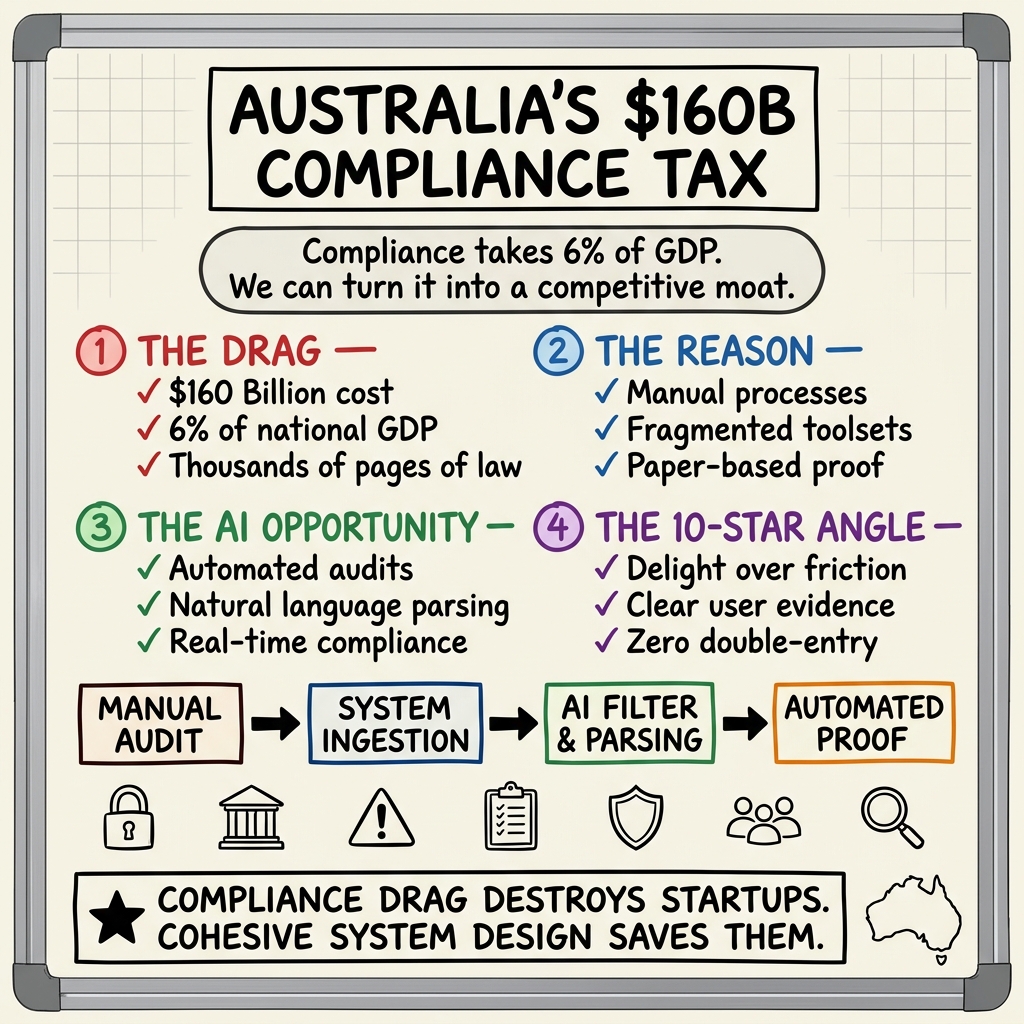
The number.
$160,000,000,000 per year.
That is what Australian businesses spend on regulatory compliance.
Most of it is humans doing things software could do.
The Scale of the Problem
     $160B COMPLIANCE BURDEN (Australia, 2026)
     ──────────────────────────────────────────

     Financial Services     ██████████  $38B
     Real Estate / Legal    ████████    $28B
     Construction           ███████     $24B
     Healthcare             ██████      $21B
     Manufacturing          █████       $18B
     Other                  ████████    $31B
This is not a technology adoption problem. According to 2025 research by Mandala Partners (commissioned by the AICD), the direct annual cost of complying with federal regulation for Australian businesses has reached $160 billion, equivalent to roughly 5.8% of Australia’s GDP. The Productivity Commission’s Dec 2025 interim report likewise estimates the compliance and delay cost range at $115–160 billion annually.
It is a productivity drain — small and medium businesses without dedicated compliance teams spending 10–15% of executive time on documentation, training, reporting, and audits.
1. Why It Has Not Been Solved
Three things have kept compliance expensive:
| Reason | What It Looks Like |
|---|---|
| Fragmentation | Different regulators (AUSTRAC, ASIC, APRA, Safe Work) with no shared data |
| Document-heavy | Most compliance is still Word docs, PDFs, and spreadsheets |
| Expertise locked up | Small firms pay $400/hour for advice that could be a $200/month SaaS |
The incumbents in this space are built for enterprise. A $500/month product that requires a demo call and a 3-month implementation does not reach a sole-trader real estate agent.
2. The AI Adoption Gap
Australia scores 3.43 out of 10 on the Napier AI / AML Index 2024–2025 (lower is better).
That sounds good until you read what it means: Australia’s financial crime compliance ecosystem uses AI less effectively than most comparable economies, ranking near the bottom in institutional sentiment (“AML attitude”) toward AI-driven reform.
Meanwhile:
- 64–84% of Australian SMBs report using AI (64% regularly using it, and up to 84% engaged in sporadic experimentation, according to AI Lab Australia).
- But less than 10% have AI integrated into their compliance workflows.
- The gap between “using AI” and “compliance-ready AI” is where the opportunity lives.
3. The Compliance Software Map
     PROBLEM                CURRENT FIX          BETTER FIX
     ─────────              ───────────          ──────────
     AML/CTF filing    →    Manual templates  →  AI-generated + filed
     Staff training    →    External courses  →  In-platform LMS
     KYC verification  →    Paper forms       →  Biometric + API
     Risk assessment   →    Consultant        →  Automated tier model
     Audit trail       →    Spreadsheet       →  Append-only log
     Regulatory update →    Email newsletter  →  Live compliance calendar
Every item in that last column is software that exists or can be built today.
4. The Bootstrap Opportunity
The compliance software market for Australian SMBs is capital-efficient to enter:
| Factor | What It Means |
|---|---|
| Regulatory-driven demand | You do not need to convince buyers. The law creates urgency. |
| Small cloud infra footprint | MVP infrastructure for a compliance SaaS costs under $500/month |
| High willingness to pay | A $5,000 fine focuses the mind. $199/month feels cheap by comparison. |
| Expansion path is clear | Real estate → conveyancers → accountants → lawyers. Same product, different skin. |
| Referral network is the sector | Real estate agents and their conveyancers talk constantly. |
This is the profile of a bootstrappable, defensible business — not because the market is small, but because regulatory urgency replaces expensive marketing.
5. The Sectors Worth Watching
AUSTRAC Tranche 2 is one cliff. But the $160B compliance burden sits across many sectors:
| Sector | Regulatory Driver | Timeline |
|---|---|---|
| Real estate agencies | AUSTRAC Tranche 2 | July 1, 2026 |
| Conveyancers | AUSTRAC Tranche 2 | July 1, 2026 |
| Accountants | AUSTRAC Tranche 2 | July 1, 2026 |
| Lawyers | AUSTRAC Tranche 2 | July 1, 2026 |
| Fintechs | APRA CPS 230 + AI governance | Ongoing 2026 |
| Construction | Workforce compliance | Ongoing |
The pattern repeats: mandatory obligation, under-resourced buyers, no affordable solution.
The Big Takeaway
Compliance is not a market. It is a $160B productivity problem waiting for a software fix.
The companies that combine regulatory knowledge with clean software will not need to compete on price.
They will win by being the only credible option in the room.
The biggest risk is not building the wrong thing.
It is assuming the market needs to be convinced.
Australia’s regulators are doing the selling. The founders just have to ship.
Related reading
- The 10-Star Experience: Why Product and Engineering Need Legendary Test Cases — how we design and test the software we choose to build.
- Who Signs the Contract When Your AI Agent Does It? — where compliance meets autonomous agents.
Written by Haris Habib from Sydney, Australia | May 2026