Today’s Australian compliance story is not that anti-money laundering rules are expensive.
That part was predictable.
The sharper story is that Tranche 2 AML/CTF obligations are now colliding with businesses whose operating systems were never designed to produce regulatory evidence at transaction speed.
On 10 July 2026, local coverage reported real estate agents warning about higher costs from the new AML/CTF regime, including outsourced identity and compliance checks being passed through to buyers and sellers. The details will vary by agency, state, customer segment, and service model. But the pattern is bigger than real estate.
Australia has moved AML/CTF obligations deeper into the transaction economy. Real estate agents, lawyers, accountants, conveyancers, and other gatekeeper professions are being pulled toward the same expectation banks and fintechs already know well:
Know who is transacting, understand the risk, escalate the exceptions, and be able to prove what happened later.
That last clause is where the real cost lives.
Important disclaimer: This article is general commentary and personal analysis only. It is not legal advice, regulatory advice, financial advice, or a recommendation to act in any particular way. AML/CTF obligations depend on your entity type, services, licence position, risk profile, and specific facts. For compliance decisions, use qualified legal, compliance, or regulatory advisers.
The compliance bill is a symptom
When a business says the new regime creates cost, it usually means several different costs have arrived at once:
- customer identification checks
- beneficial ownership discovery
- risk assessment and screening
- exception handling
- suspicious matter escalation
- staff training
- policy and program maintenance
- audit evidence retention
- vendor contracts and assurance
Some of that can be outsourced. Some of it can be automated. Some of it has to remain a human judgement call.
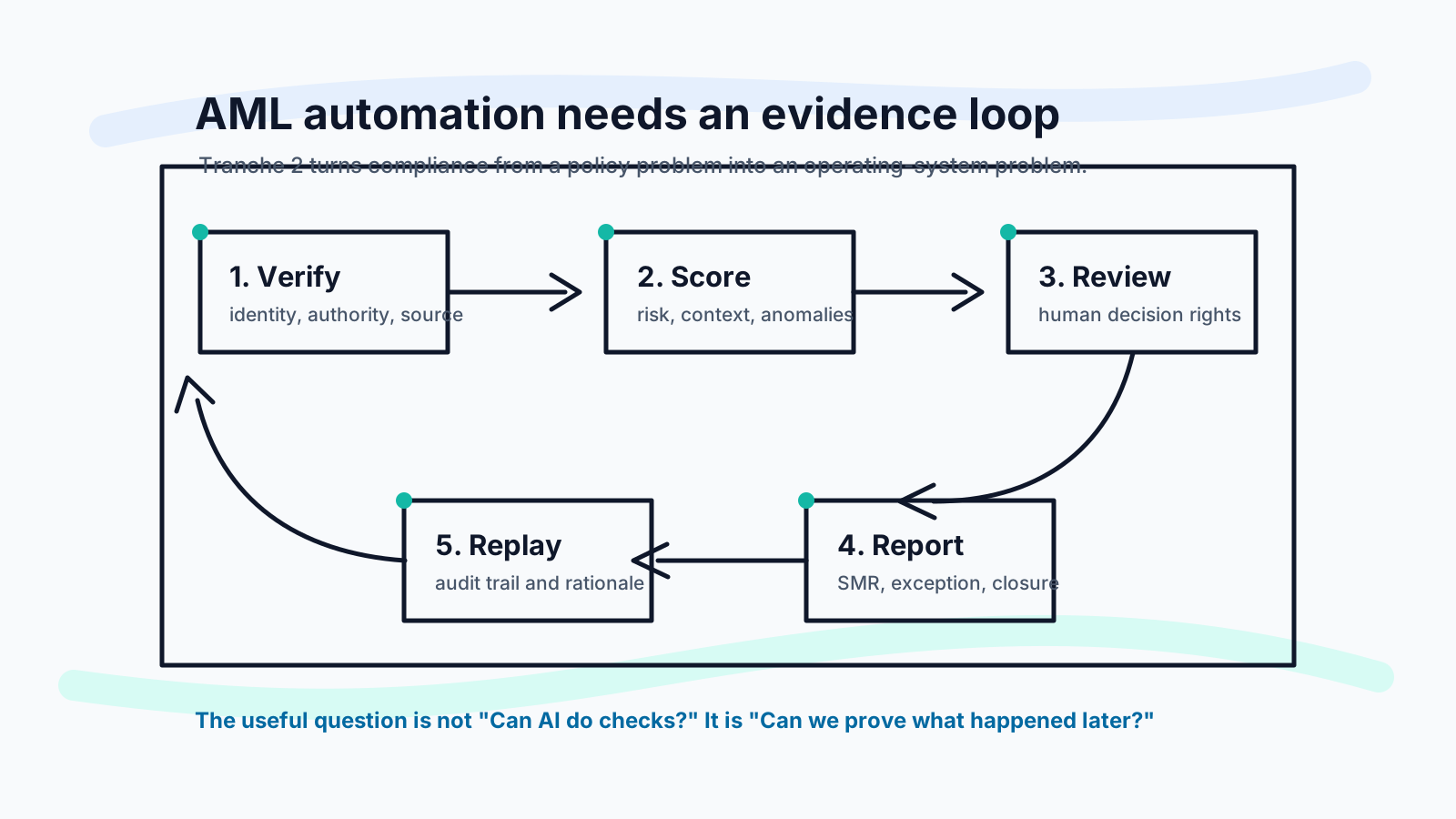
But treating these as separate line items misses the product architecture problem. AML/CTF is not a folder of procedures. It is a loop.
The loop looks like this:
- Verify: capture identity, authority, ownership, and source information.
- Score: assess transaction, customer, geography, product, behaviour, and counterparty risk.
- Review: route exceptions to a human with clear decision rights.
- Report: lodge, close, or escalate with a recorded rationale.
- Replay: reconstruct the decision later for audit, dispute, regulator enquiry, or internal assurance.
If those steps live in five disconnected tools, the business pays twice. It pays once to run the process, and again to stitch together evidence when someone asks what happened.
That is the part many compliance-cost debates understate.
AI helps only if it is boxed in
This week’s AI safety debate in Australia gives the AML story a second edge.
The federal government’s AI Safety Institute is testing frontier models, and Assistant Minister for Technology Andrew Charlton has warned that AI systems are already displaying behaviours their creators did not intend. The government’s posture is not “wait for one grand AI Act”. It is to use existing sector regulators and existing laws, strengthened where needed.
That matters for AML automation.
AI is genuinely useful in compliance operations. It can help triage documents, spot inconsistent records, summarise case notes, detect unusual transaction patterns, cluster related entities, and reduce the amount of low-value manual review. Recent AML research is also moving toward synthetic data and agent-based simulations because real laundering labels are scarce, incomplete, and hard to share.
But in regulated environments, usefulness is not enough.
An AI-assisted AML workflow needs boundaries:
- what the model is allowed to recommend
- what it is never allowed to decide
- what evidence it must preserve
- when a human must review
- how false positives and false negatives are measured
- how model drift is monitored
- how the business explains the outcome later
Without those boundaries, AI does not reduce compliance risk. It converts a visible manual backlog into an opaque automated one.
That may feel cheaper for a quarter. It is not a durable control.
The RegTech opportunity is not another dashboard
The lazy version of the RegTech opportunity is “100,000 businesses now need compliance software”.
The better version is more specific:
Australia needs RegTech that turns fragmented AML obligations into replayable evidence.
That means products should compete less on dashboard screenshots and more on evidence design.
Can the system show which identity evidence was collected, which risk rules fired, which records were missing, who reviewed the exception, what they saw at the time, what decision they made, and what changed afterwards?
Can it separate a low-risk customer update from a high-risk transaction involving complex ownership, offshore entities, politically exposed persons, or unusual source-of-funds signals?
Can it give small firms a proportionate workflow without pretending that a policy PDF is the control?
Can it help larger firms prove consistency across branches, partners, and outsourced service providers?
That is where the value is.
The winning products will not merely “do KYC”. They will reduce the cost of producing trustworthy evidence.
The human review layer needs design
One of the most dangerous phrases in AI governance is “human in the loop”.
It sounds reassuring. It often means very little.
In AML/CTF, human review has to be designed with the same seriousness as the model or rules engine. A reviewer needs enough context to make a decision, enough authority to override the system, and enough structure to record why they acted.
A weak human review layer looks like this:
- an alert appears with no useful explanation
- the reviewer opens three other systems manually
- the customer file is incomplete
- the risk score is unexplained
- the reviewer clears the case under time pressure
- the rationale is a two-word note
- no one can reconstruct the decision six months later
A stronger pattern looks different:
- the alert shows the triggering facts
- identity and ownership evidence is attached
- the reviewer can see previous exceptions
- the system explains whether AI assisted the triage
- the reviewer chooses from structured outcomes
- free-text rationale is available for nuance
- the final decision is stored with timestamp, inputs, and version context
That is not bureaucracy for its own sake. It is operational memory.
Small businesses should not need bank-grade machinery
There is a fairness issue here too.
A suburban agency, boutique law firm, or small accounting practice should not need the same machinery as a major bank. Proportionality matters. Risk-based compliance is supposed to recognise that different businesses have different exposure.
But proportionality does not mean no evidence.
For smaller firms, the target architecture should be lighter:
- guided onboarding instead of free-form document chasing
- reusable customer and beneficial-owner records
- clear escalation prompts for unusual transactions
- simple decision logs
- vendor-managed retention and export
- plain-language review queues
The policy question is how much burden Australia is prepared to place on gatekeeper professions. The product question is how much of that burden can be absorbed by better workflow design.
Those are different debates. Mixing them together produces bad software and worse policy.
What builders should take from today
If you are building in Australian FinTech or RegTech, today’s signal is not “add AML features”.
It is this:
Compliance cost is becoming a product-market signal.
Where businesses complain about cost, look for the unpriced workflow:
- evidence collected twice
- exceptions handled in inboxes
- identity checks detached from risk scoring
- AI outputs stored without model or prompt context
- reports lodged without clean case history
- audit exports assembled manually
That is the work.
The next wave of Australian compliance software will be judged by whether it can make the evidence loop feel native to the transaction, not bolted on after settlement, onboarding, or advice.
Tranche 2 is the forcing function. AI is the accelerant. But the architecture problem is older than both.
Regulated businesses do not just need to comply.
They need to remember, precisely and defensibly, how they complied.
That is where the real build opportunity sits.
Written by Haris Habib from Sydney, Australia | 10 July 2026