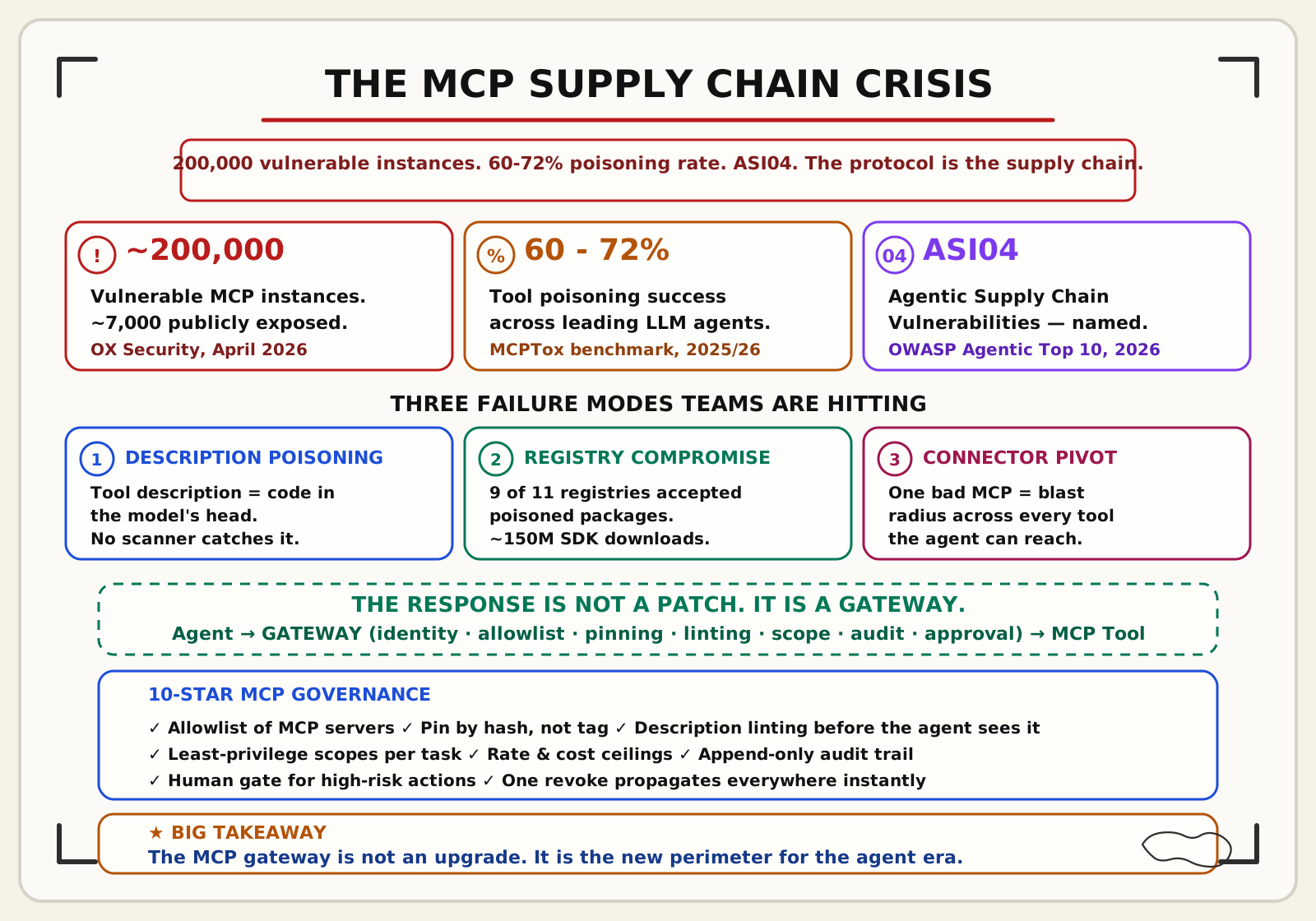
The number that should keep you awake. 97% of enterprises expect a major AI agent security incident within the year. Two-thirds have already had one. The Sysdig intrusion was not an anomaly. It was a preview.
The Intrusion Nobody Saw Coming
In May 2026, a major cloud-native security vendor disclosed an intrusion that weaponised their own agent runtime. Adversaries did not breach a perimeter. They did not phish a credential. They compromised the tool supply chain of an AI agent itself.
The attack followed a clean path:
Agent installs tool → Tool loads dependency →
Dependency carries compromised package →
Attacker now has the agent's permissions
No zero-day. No exploit. Just a dependency chain that nobody was monitoring — because nobody thought to monitor the agent’s supply chain separately from the application’s.
The Moltbook/OpenClaw incident that followed in June proved the pattern was repeatable. Adversaries hijacked security tools at over 90 organisations. Not by attacking the organisations directly. By poisoning the tools their AI agents were authorised to use.
Why Agent Supply Chains Are Different
A traditional software supply chain attack targets your build pipeline or your deployed binaries. You have tools for that: SBOMs, dependency scanners, signed commits, Trivy.
An agent supply chain attack targets a different layer entirely.
| Traditional supply chain | Agent supply chain |
|---|---|
| Attack vector: build artifact | Attack vector: tool capability |
| What is compromised: your code | What is compromised: the agent’s authority |
| Detection: CI scanners | Detection: nothing standardised yet |
| Blast radius: one application | Blast radius: every system the agent can touch |
| Recovery: roll back the binary | Recovery: audit every action the agent took |
When an agent has access to your database, your CI/CD, your cloud console, and your internal APIs, the blast radius of a poisoned tool is not one service. It is everything the agent is authorised to do.
Microsoft’s Response and What It Signals
Within weeks, Microsoft shipped an open-source toolkit for governing autonomous AI agents. The package includes:
- Tool allowlisting: Not “which tools?” — “which versions, from which registries, signed by which identities?”
- Capability scoping: Per-task permission boundaries — an agent writing code cannot also approve pull requests
- Evidence trails: Every tool call, every parameter, every outcome logged in a non-repudiable format
- Failure mode taxonomy: Updated after a year of red teaming agentic systems
The speed of Microsoft’s response tells you the severity of the signal. When the largest enterprise software vendor in the world ships a governance toolkit within weeks of an intrusion, it is not a coincidence. It is an acknowledgement that the agent supply chain is the new attack surface.
What Australian Builders Should Do Now
For Australian CTOs and engineering leads, operating context matters. We operate under the Privacy Act, APRA’s CPS 230 for regulated entities, and ASIC’s 2026 Risk Radar — which explicitly flags AI governance as an enforcement priority.
Here is a practical checklist:
1. Inventory Your Agent’s Tools
Before you can secure a supply chain, you need to know what is in it. For every AI agent in production or near-production:
- List every tool, plugin, and MCP server the agent can call
- Trace the dependency tree of each tool
- Flag any tool with filesystem, network, or credential access
- Ask: does this agent actually need this tool?
You will find things. Every team does.
2. Separate Agent Identity from Human Identity
The agent should not run as you. Give it:
- A dedicated service account
- Scoped permissions — read-only by default, write only where necessary
- Time-bound credentials that rotate automatically
If the agent is compromised, you want to revoke its access — not yours.
3. Lock Tool Versions and Registries
An agent that pulls tools dynamically from a public registry is an agent that can be poisoned:
- Pin tool versions — no floating tags, no
latest - Use a private registry or mirror for production tools
- Require checksum verification before the agent loads any tool
4. Build an Agent Audit Trail
Standard application logs tell you what your service did. Agent audit trails need to tell you:
- What prompt triggered the tool call
- Which tool was called, with what parameters
- What the tool returned
- What the agent did with that return value
- Whether a human approved the action
If you cannot reconstruct an agent’s decision path, you cannot defend it to a regulator, an auditor, or a customer.
5. Run Agent-Specific Red Team Exercises
Your existing pen tests are not testing your agent attack surface. Add:
- Tool poisoning: What happens if a dependency is compromised?
- Prompt injection through tools: What if retrieved content tells the agent to ignore its policy?
- Over-authorisation: Can the agent chain tool calls to escalate its own privileges?
- Recovery: If the agent is compromised, can you isolate it without taking down production?
The Australian Regulatory Angle
Under the Privacy Act, the test is whether an organisation has taken “reasonable steps” to protect personal information. If your AI agent is processing personal data through its tool calls, those tool calls are part of your data handling chain. A poisoned agent that exfiltrates client data through a compromised tool is a Privacy Act incident.
For APRA-regulated entities, CPS 230 requires that operational risk management covers all material service providers. An agent that can touch customer data, approve transactions, or modify system configuration is a material service provider. The supply chain of that agent’s tools belongs in your risk assessment.
ASIC’s 2026 Risk Radar has put AI governance on the enforcement agenda. The question is not whether they will audit agent security. It is when.
The Big Takeaway
The agent supply chain is the software supply chain problem, amplified. An agent does not just run your code. It makes decisions, calls tools, and acts on your behalf. Its dependencies are not just libraries. They are capabilities. Securing them is not optional. It is the prerequisite for trusting agents with real work.
The Sysdig intrusion was not a wake-up call. It was confirmation that the industry was right to be worried.
The 97% of enterprises expecting an incident are not being pessimistic. They are reading the same signals.
If you are building with AI agents, the checklist is clear: inventory your tools, scope your permissions, lock your dependencies, build your audit trail, and red-team your agent surface. The teams that do this before an incident will have an answer when something goes wrong.
The teams that wait will have a cleanup — and an awkward conversation with their compliance officer.
Related reading
- The Docker Moment for AI Agents — the infrastructure shift this is part of
- MCP Supply Chain Crisis: Why Every CTO Needs a Gateway — the protocol-level vulnerability
- MCP Tool Poisoning: The Attack Vector Nobody Is Talking About — how tool poisoning works
- Your AI Agent Needs a Soul File — identity, memory, and persistent agents
- What ASIC’s AI Risk Radar Means for Your Startup — the regulatory landscape
- One Model Is the Wrong Default — agent architecture design
Written by Haris Habib from Sydney, Australia | June 2026