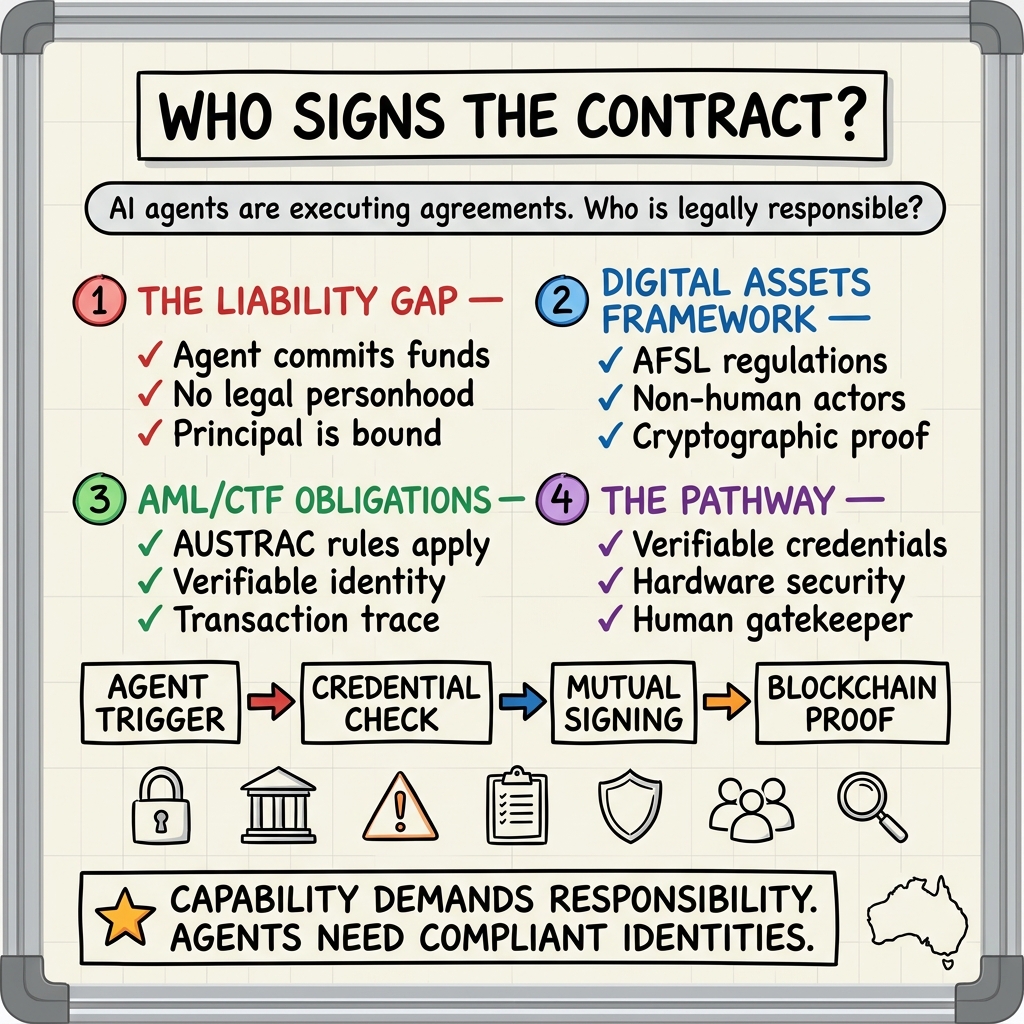
One sentence.
When an AI agent pays a vendor, files a compliance report, or executes a smart contract — existing law does not know who is responsible.
The New Reality
Autonomous AI agents are no longer demos.
They are:
- Approving invoices and making payments
- Filing compliance reports with regulators
- Executing A2A (agent-to-agent) financial protocols
- Signing API contracts on behalf of companies
This is happening right now in production systems across fintech, legal, and professional services.
1. The Identity Gap
     TRADITIONAL TRANSACTION           AGENTIC TRANSACTION
     ─────────────────────             ───────────────────────
     Human → Verified Identity         Agent → ??? Identity
     Human → Accountable               Agent → Who is liable?
     Human → Audit trail               Agent → Was it logged?
     Human → Override possible         Agent → Who stops it?
Every financial transaction in Australia requires a verifiable identity behind it.
An AI agent has none of the above by default.
It uses the credentials of the service it runs on — which means the liability falls on the company running it, without a clear evidentiary trail showing who actually authorised the action.
2. The Three Questions AUSTRAC Will Ask
When something goes wrong with an autonomous financial transaction, regulators will ask:
- Who authorised this agent to act? — Was there human approval before execution?
- What did the agent do? — Is there a complete, tamper-proof log of every action?
- Could a human have stopped it? — Was there a review gate before final execution?
Current agent stacks (LangChain, AutoGen, CrewAI, Claude Code) are powerful but do not provide these by default.
3. The Digital Assets Framework Makes It Urgent
The passage of Australia’s Corporations Amendment (Digital Assets Framework) Bill 2025 (which received Royal Assent on 8 April 2026, and commences on 9 April 2027) places crypto assets firmly under the Australian Financial Services Licence (AFSL) regulation.
That means when an AI agent:
- Executes a smart contract
- Moves funds via a crypto wallet
- Settles a tokenised asset transaction
…the agent’s action is now a regulated financial service — and the question of cryptographic identity becomes a compliance requirement, not a design choice.
4. What “Agent-KYB” Looks Like
The emerging standard for agentic financial identity has five components:
| Component | What It Does |
|---|---|
| Cryptographic Agent Identity | A unique, verifiable identifier per agent instance |
| Authorisation Chain | Proof that a human principal approved the agent’s scope |
| Execution Log | Append-only record of every action the agent took |
| Human-in-the-Loop Gate | A required review point before irreversible financial actions |
| Revocation Mechanism | A way to suspend agent authority without rebooting the whole system |
This is the “KYB for agents” — Know Your Bot.
5. The Opportunity Window
| Sector | Why They Need Agent-KYB Now |
|---|---|
| Fintech / payments | AFSL obligations now extend to automated crypto execution |
| Real estate compliance | AML Hive agents filing SMRs need a trusted identity chain |
| Legal / conveyancing | Automated document preparation and filing requires auditability |
| Enterprise AI deployment | SOC 2 and APRA CPS 230 (effective 1 July 2025, with existing contracts compliant by 1 July 2026) are asking for agent governance evidence |
The companies that build Agent-KYB as a product — not just a whitepaper — will own the compliance layer for the next decade of autonomous AI.
The Big Takeaway
Capability without identity is just risk.
The winning strategy in regulated AI is not the fastest agent.
It is the agent with the cleanest audit trail.
Australia’s regulatory window — AUSTRAC, Digital Assets Framework, APRA’s AI guidance — has created a 12–18 month gap between what agents can do and what they are legally permitted to do without oversight.
That gap is the product.
Related reading
- MCP Tool Poisoning: The Attack Vector Nobody Is Talking About — the attack surface that makes agent identity urgent.
- I Gave an AI Agent the Keys to My Life. Here Is the Trust Architecture. — what the controls look like in practice.
- The 10-Star Experience: Why Product and Engineering Need Legendary Test Cases — designing trust and delightful assurance into agent workflows.
Written by Haris Habib from Sydney, Australia | May 2026