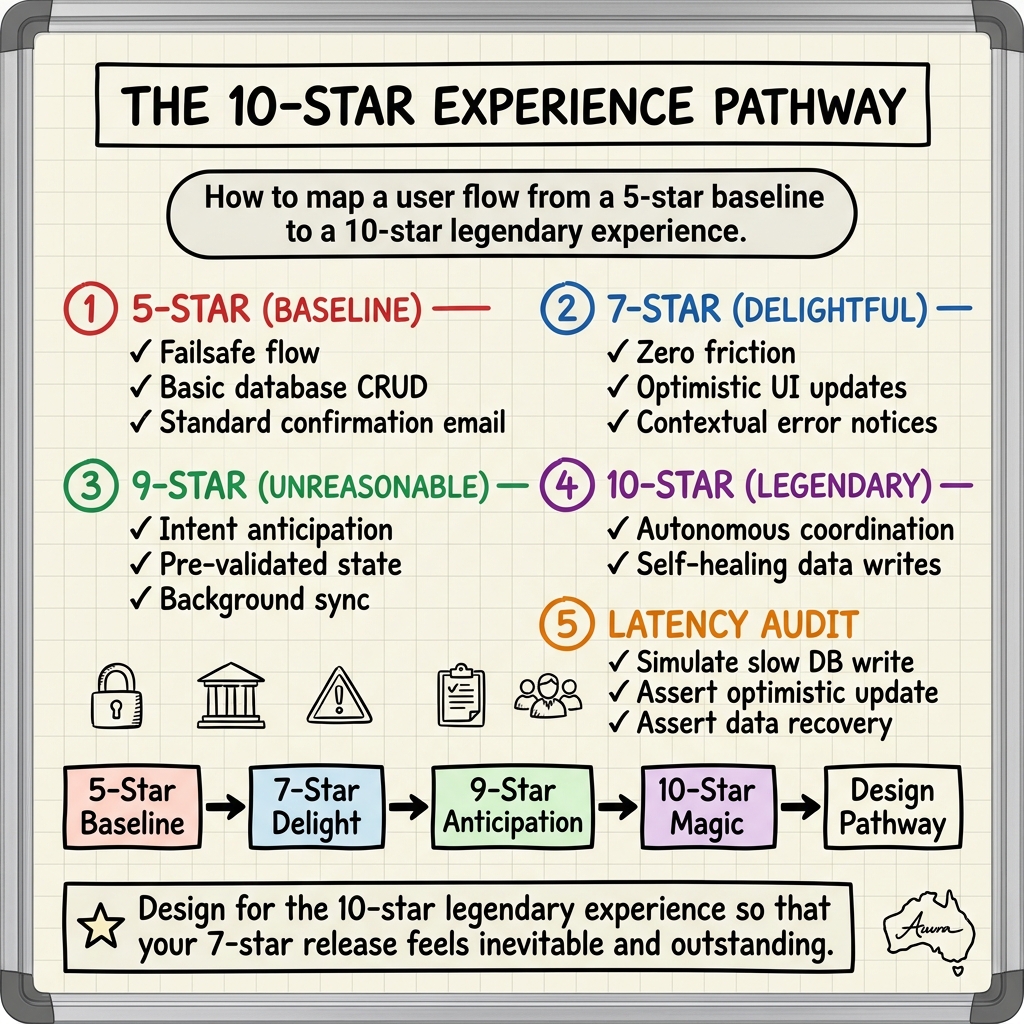
The standard.
A 5-star test case checks if the system works.
A 10-star testcase checks if the customer is wowed.
The gap between the two is where premium software is made.
When Brian Chesky (Airbnb’s co-founder) describes product design, he uses the framework of the 10-Star Experience.
If you design a 5-star experience, it is standard: you arrive at the Airbnb, you get in, and the bed is clean. It works, but it is a commodity.
To design a 10-star experience, you imagine something unreasonable: a limousine picks you up at the airport, your favourite drinks are waiting, Elon Musk is there to welcome you, and you go to space. It sounds ridiculous. But when you scale that back to what is technically and commercially feasible, your standard release naturally elevates to a 7-star experience—one that makes customers advocate for you.
For technical teams, this is not just a product exercise. It is an engineering discipline.
If your QA, testing, and architecture are only designed to prove the 5-star checklist (e.g. “Assert 200 OK”), you will only ever ship a commodity.
Here is how to run the 10-star pathway exercise, and how to write the engineering test cases that back it up.
1. The 10-Star Experience Pathway Worksheet
In our startup validation scorecard, we include the 10-Star Path as a primary validation gate. If we cannot map a legendary version of the user flow, the idea remains stuck in the backlog.
Here is the worksheet we use to map the user journey:
| Stage | Experience Description | Engineering Challenge |
|---|---|---|
| 5-Star (Standard) | The user enters their details, hits submit, waits for a spinner, and receives a generic confirmation email. | Standard CRUD database writes, SMTP email integration. |
| 7-Star (Delightful) | The page feels instantaneous. Fields auto-populate. If a step fails, the system explains exactly why and offers a one-click fix. | Optimistic UI updates, context-aware error handlers, local caching. |
| 9-Star (Unreasonable) | The system anticipates the intent before the user finishes. It surfaces contextual insights, drafts the next step, and requests approval with zero friction. | Edge intelligence, real-time sync, background pre-fetching, pre-validated actions. |
| 10-Star (Legendary) | A dedicated assistant coordinates the entire workflow across systems, handles exceptions autonomously, provides an immutable audit log, and notifies the user only when the outcome is achieved. | Fully autonomous agents, cryptographic proof chains, self-healing database transactions. |
The goal is not to ship the 10-star space-travel option. The goal is to let the 10-star vision guide what you build for the 7-star target.
2. What is a 10-Star Test Case?
In standard engineering, test cases look like this:
it("submits the compliance report successfully", async () => {
  const response = await api.submitReport(mockData);
  expect(response.status).toBe(200);
  expect(response.body.success).toBe(true);
});
This is a 5-star test. It proves the plumbing works. But it tells you nothing about the reader or customer experience.
A 10-Star Test Case tests the quality of the experience under stress. It forces the software to handle latency, cognitive friction, user mistakes, and platform failures gracefully.
Here are the four pillars of a 10-star test suite:
A. The “Zero-Latency” Test Case
A 10-star experience does not make the user stare at a spinner.
- The Test: Simulate a 3,000ms database write latency.
- The Expectation: The UI must update immediately (optimistic UI), allowing the user to continue their work. If the write eventually fails, the UI must transition back smoothly, preserve the user’s inputs, and alert them without losing data.
B. The “Context-Aware Error” Test Case
Standard error states say “An error occurred (Code: 500)”. This is a 1-star experience.
- The Test: Trigger a third-party API outage during transaction execution (e.g., an AUSTRAC reporting gateway failure).
- The Expectation: The system should not crash or show a stack trace. It must:
- Save the payload to an offline retry queue.
- Display a human-readable notice explaining that the gateway is down but their submission is secure.
- Automatically retry when the gateway recovers.
C. The “Friction Audit” Test Case
Friction kills adoption. If a user needs to copy-paste data between three tabs, the architecture is broken.
- The Test: Map the user journey inputs.
- The Expectation: No input field should require double-entry. If the user has already uploaded a PDF containing company formation data, the parser must extract it, populate the form, and only ask the user to verify.
D. The “Resilient-by-Default” Test Case
What happens when the user closes the browser mid-transaction?
- The Test: Terminate the user session or disconnect network access while a multi-step compliance wizard is 80% complete.
- The Expectation: When the user returns (from any device), the system restores the exact state locally from append-only session logs, allowing them to resume without starting over.
3. How to Apply the Pathway to Your Roadmap
If you are building startup products or enterprise systems in Australia, you are operating under tight budgets and compliance clocks. You cannot build 10-star features for every flow.
Instead, pick the one critical loop that defines your value proposition.
- If you are in fintech, it is the first payment execution.
- If you are in compliance, it is the first audit report generation.
- If you are in AI tools, it is the first prompt-to-output latency.
Run the 10-star pathway exercise for that loop alone. Write down what a legendary experience feels like, and translate those expectations into concrete unit tests.
The result is software that does not just satisfy a requirements document. It is software that feels inevitable, premium, and impossible to leave.
Related reading
- Australia’s $160 Billion Compliance Tax — where 10-star customer delight meets heavy regulatory constraints.
- Your AI Agent Needs a Soul File — designing 10-star continuity for stateless models.
Written by Haris Habib from Sydney, Australia | May 2026